It’s quite easy to say you like something these days. All you need to do is press ‘like’ on facebook and everyone can see you like it. But it’s quite meaningless and hollow isn’t it?
Of course I don’t like cancer, and of course i’m against racism, but clicking ‘like’ does absolutely nothing but give the person who started the chain of public pointlessness a warm glow and a stirring in their pants at their ability to move social media mountains. It doesn’t save lives and it doesn’t raise any money for the causes we are liking.
Does it mean a little more when you retweet, or favourite some else’s tweet? Probably. But not much more. Single button support is all too simple.
Next for me on the hierarchy is a text. it’s pretty easy and painless and doesn’t commit you to anything much really. It gives you a glow and them a vague feeling you’re there for them.
But if it really mattered or you wanted them to know it was important to them, you’d ring them wouldn’t you and tell them? With a mobile in every pocket, that’s ever so easy and ever so fast. It’s over and done with in a flash.
But at the top of my new social hierarchy is a letter.
If it matters, then write. By hand. The old fashioned way. Craft it a little and show people that what you think of them and that you care enough to put pen to paper.
A little while ago, I read this article called the $300m button. Whilst I took some of it with a pinch of salt, it made me think and change the way I advise clients on their Internet and social media behaviour.
But I’ve now discovered that I am living it myself. I have stopped wanting to become friends with organisations online, unless they are amongst my very few special online friends.
So there is a very simple lesson for all of us involved with brands, websites and social media strategies. Stand in your own shoes and see how you behave.
I probably don’t want to be your mate. if I do, I want it to build slowly and get to know you first, before I commit long term.
Ooh, that sounds rather like building a normal relationship doesn’t it?
So, the new lesson i’m sharing everywhere is that you mustn’t expect people to create a unique user name and password to buy, comment or login to your site. keep it simple, keep it slow and let them log in with their Facebook, Twitter or Google identity and you will make far more friends and build a far more active community. When they show they want to get to know you, that’s when you think about moving the relationship up a gear.
I was sent this article from e-consultancy by the very clever Rosalind Johnson at A Different View and whilst it works, I think they could have gone a stage further.
So what can’t social media do for you and your brand?
1. Make you cool
Everyone is on social media platforms, but few have a properly joined up strategy as to why they’re doing it. There’s more chance of you getting it wrong and being caught ‘dad dancing‘ by the very people you are trying to win over. If in doubt, don’t do it at all.
2. Create great products & services
Great products comes from a balance f inspiration, striving for quality and listening to what your customers needs, wants and dreams. You can listen to what they are telling you if you’re any good on these social channels, but As Henry Ford said, ‘If we’d asked our customers what they wanted, they would have said a faster horse’.
3. Quash criticism
People are talking about you already, good or bad. Social media allows you to listen and respond (if you do it well), but if you’re crap at everything else, you’ll still get criticism – rest assured if you pretend you’re listenibg and do nothing, it only gets worse (doesn’t it National Rail!)
4. Provide free marketing
This is a total myth, it costs time and money to do it well. Again, if you can’t do it right, you’re better off not doing it at all. My figures proved that here.
5. Improve your customer service
You can’t polish a turd, but you can roll it in glitter. The more you advertise a bad product, the faster it will fail and all the other ways of describing a disguise for bad products or service ring true. Customers have access to all the information in the world and are not afraid to tell people. If you get caught telling lies on a social media platform, your life will get worse and worse. The only way to solve it is to ‘fess up and sort the problem.
You may well have seen this ad already. My children dragged me onto YouTube to see it, they liked it so much. I do to.
A few things strike me about it.
1. The branding is almost too subtle. The first shots of him holding the milk carton display no branding whatsoever, other than the green stripe around it.
2. It is properly joined up in it’s social media. The Twitter account is well worth a look and it is written (or tweeted) beautifully in character of a slightly sinister cat Bertrum Thumbcat.
3. It is very cleverly built with embedded links into the video. This means that it must be a paid for placement as YouTube don’t allow for link embeds as we have discovered with my son’s social media experimenting.
4. It is ripe for running. By this, I mean that this will be the first of a series of ads to follow in the same storyline, like the Meerkat ones. I’m quite looking forward to seeing the Thumb Cats slowly taking over the world.
Congratulations, you’re our second HSBC 100 Thoughts winner.
As a winner you are invited to one of the HSBC 100 Thought events. These events are taking place around the country and there will be a number of business thinkers and influencers making up the panels. You will get exclusive access to the panel at your chosen event.
Your thought will also be entered into a public vote and if you win you’ll receive a one to one consultation with a globally renowned business guru (who we will be announcing very soon).
I’ve listed the events below for you to choose from. Not every panel has been firmed up yet but I’ve entered the ones we know for you. They start fairly early and are finished by around 10.30 so you shouldn’t need much time out of work to attend.
Please let me know which event you’d like to come to. We will pay for travel, via standard class rail or mileage rates approved by HM Revenue & Customs, to and from the event and this will be reimbursed after the event.
And the thought?
“#100thoughts if you really want to improve your business, why not give your customers a really good listening too.”
Which is something we have been talking about for ages anyway, as the problem with most social media strategies is that they involve a lot of talking and not enough listening.
Funnily enough, my other entry “#100thoughts if you can’t change the people, change the people.” didn’t get picked!
Just to prove it’s one we believe in, we did employ a bit of good listening only yesterday to our good friend and client Lisa Harlow, who has given us some direct feedback as to how we can simplify our own presentation at Purple Circle. Her idea is being actioned now and will be live on our website within the next day or so! It works.
Edith Boundy - 95 years old on Tuesday and better at listening than 95% of all businesses that use social media as marketing tool
I’m a big fan of social media, it’s great fun and quite sociable really. But is it right for most brands or is it just a great big distraction?
Having given this lots and lots of thought, I’m becoming more convinced that a social media strategy for many B2B businesses is nothing more than a total waste of time that will ultimately serve to undermine their business.
A big statement, but lets look at the facts.
Email marketing
Sending lots of emails to your clients keeps them abreast of what you do.
If you’re doing well, as a B2B business you may have a 40% open rate. This is a 60% NOT open rate so more of your customers are choosing to not even look at the information you are sending them.
Lets say this takes 4 hours per month
I blog loads and loads that build links and web presence
But how many people read it and how is this adding to the SEO of your own company? It is far better to use all of your hard work blogging to populate your business’ site with lovely searchable words that Google can crawl all over and rank you more highly for than build an external blog presence.
You have to be incredibly committed to build an external blog with a Page Rank that will make the link back to your business site worth the effort. Realistically, one link from Linkedin to your business site will do more good.
To do this well will take 15 hours per month
I’m always Twittering
Unless you make the effort to build an engaged audience, you may as well not bother. How many people are actually listening to what you say. Most (over 80%) of twitter accounts are effectively dormant, so who cares? Are you shouting your thoughts in an empty room.
To do this well will take 6 hours per month
Facebook
It’s nice to see your business down their with the kids and yes it’s a huge fast growing audience base. But for B2B. Hmm, not really.
Will you sell more widgets, buns or B2B services by having a Facebook fan page? I doubt it. At least once it’s up, maintaining it is pretty simple, so lets say we allow 2 hours per month.
For consumer brands it can be completely different, they try to build religious fervour where people seek them out and want to know more and more. Their reputation can grow like wildfire with consumers looking for information in every available channel. So yes, I can see why you just have to have it here.
But if you’re a B2B supplier, wouldn’t the TWENTY SEVEN hours every single month, you’ve just saved be better spent hanging out with your clients and giving them a really good listening too?
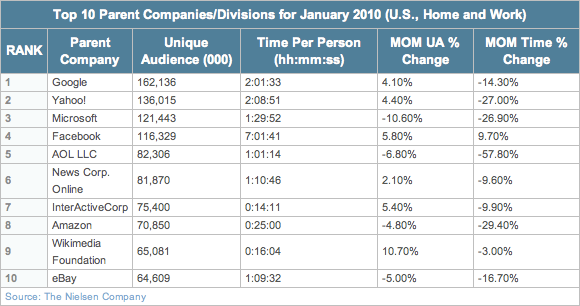
According to some new figures by Nielsen the average Facebook user spent seven hours of their precious time on Facebook in January. That sounds like about six hours and thirty minutes too much to me, but then again, I’m not generally stuck for things to do in the evening.
Top 10 Parent Companies/Divisions for January 2010 (U.S., Home and Work) - facebook is the biggest winner in the time wasted in front of your computer
Perhaps even more amazing for Facebook is that this time absolutely dwarfs the time spent on the other top ten platforms made up from their parent companies of:
Google, Yahoo!, Microsoft, Facebook, AOL, News Corp. Online, InterActiveCorp, Amazon, Wikimedia Foundation and eBay
With the nearest rival being Yahoo at two hours and eight minutes. That is weird. Why would anyone spend any time on Yahoo at all?
And again it shows that time spent on ALL of the other platforms is falling month on month. When you consider in large parts of the world, January was a snowy month, with loads of kids off school, logic would say that all of them would have spent more time online.
So from this I draw two possible conclusions:
1. Facebook has become the dominant web application of its generation. Yes Google is one we use a lot, but clearly not one we connect too and even the launch of their Buzz product may not be enough to make an impact on the strength of Twitter or Facebook.
(I registered for Buzz, but not sure why, what it does or even how to find myself on it! If anyone can help, that would be nice.)
If you own a brand and want to build a future, trying to do so without a sensible Facebook strategy, will ensure you have afar worse chance of succeeding.
2. Kids are learning how to play again. Maybe this is a bit of a stretch on my part, or maybe its just me being hopeful, but I have to conclude that all of the kids in the snowy northern hemisphere chose to go out and play in the snow, rather then veg out in front of their computers. I like this conclusion very much, it’s good for our future.
I would say that we are currently getting more enquiries about social media than any other area of our business and along with iPhone Apps can see that we have many fun hours in front of our computers spending time devising strategies to get kids to engage with brands – or hopefully getting them to engage with brands that live outside.
It was a big day yesterday on my blog and I saw the huge power of social media first hand.
Around lunchtime whilst talking in the office, I really thought that we had uncovered the fact that the RATM Christmas number one was a scam that had been funded by Sony to get sales for all their artists up. I didn’t like the manipulation it implied, so I started digging.
I put two and two together and made twelve.
There are so many coincidences that point towards it being a set up, I thought I would run with it and see what came out.
The most amazing thing was quite how fast the truth did come out.
I put the post up at 2pm and by late afternoon there were those who believed the story and those who violently opposed it. There were RATM fans who went to such lengths to defend their band that I was genuinely shocked.
And then the lady at the centre of the whole conspiracy theory came on to the site and put her side of the story. Later that day we spoke at length on the phone and I was reminded very simply of the human side to this. What started as a laugh for Jon and Tracy Morter became a beast that they simply couldn’t control.
There were hundreds and maybe thousands of people who just didn’t believe they could have done it for nothing (me included) and that is because social media channels and conspiracy theorists started to paint them as orchestrating gurus, pulling the strings for big business.
Social media has immense power. It has the power for social change and social good as well as massive media manipulation. But it also has the power to get things wrong and escalate things out of control.
Not all of the information on the Internet is correct, we all know that. Many coincidences are just that, coincidences.
For me, Jon and Tracy Morter are a slightly geeky, Internet obsessed couple who have been caught in the middle of a prank that grew beyond anything they could have imagined.
I’m sorry that I added to their woes, but very pleased with the fact that they have been able to come on here and have a voice that clears their name so conclusively.
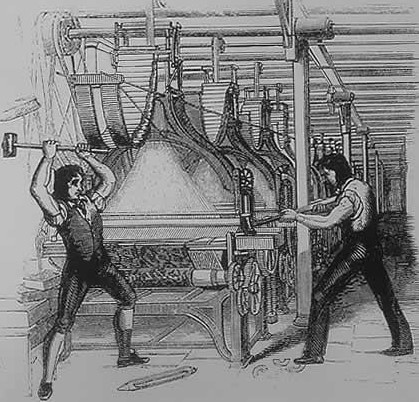
The Luddites, fighting against change that was happening anyway
There are two growing schools of thought with regard to social media.
School 1 – lets call them the Luddites
This social media lark isn’t for me. I am an estate agent, I sell widgets, I sell whatever. It’s all about wanky celebrities telling you what they’ve had for lunch isn’t it? Facebook is a load of teenagers that want to share their pointless pictures and get off with each other on the web, without meting each other and Google domaniates the search world and always will.
And there’s school 2
Lets call them sensible people, who understand that change is happening and happening fast. Those who don’t change will not survive. It’s a plain and simple fact.
I’ll steal a Charles Handy quote from my mate Tim Garratt’s ‘Adapt or Whither’ Blogpost here.
“If you boil water and drop a frog in it – it jumps out immediately. However, if you put that frog in a pot of cold water and slowly heat it, the frog adapts its body temperature to that of the water until at 100 degrees centigrade it boils alive”
It is a case of adapt or die. Those who don’t notice the change soon enough, will be left behind so completely, they will die.
Who would want to move into the printed media world right now?
Which is likely to grow fastest – printed or online media?
So I’ll give you some examples.
1. WordPress
They now provide more powerful and open source Content Management Systems (CMS) than almost anything else out there and it’s practically free. Their business plan is about selling small additional enhancements to many people for very little. We feel no pain in dealing with them and as I have shown here, they offer better customer service than anyone else in the CMS market anyway.
So traditional CMS is dead within the next few months or years. That’s a big or even huge market wiped out at a stroke. There were some bigger companies paying over £1m for a big CMS with less usbilty than WordPress offers now.
2. Traditional newspaper models
When Alexander Lebedev’s bought the London Evening Standard, according to the Guardian he paid £1. The Daily Mail & General Trust which owned the paper could see the writing on the wall in the paid regional daily newspaper sector and got out before the losses became too big. He has now switched it to a free model, so provides a great free product that has a chance of survival if it can grow its circulation again.
They were killed by their own Metro product distributed free in the mornings. They were damaged before this by us just getting out of the habit of reading papers and taking our news via all of the other media channels now open to us.
Evening papers are dependent on advertising revenue and with falling circulations, they couldn’t even attract the advertisers who are ALL switching to the more easily accountable online advertising routes.
There is still, without doubt a market for printed material, but it’s evolving fast and moving into niches rather than the mainstream. This was discussed in more detail here.
3. Printed books
I just didn’t get the point of e-books. I can’t say i’m going to own one anytime soon. I am an avid reader and I love printed books. My house and office is full of them. I love their smell their feel and the thought of sitting down to relax for a good read.
But there is a generation that doesn’t get it. Why would you carry hundreds of bulky books, when you can get them all on one good e-reader or Kindle?
And this is my point.
Its a generational change.
This generation are different. Like we as a generation are completely different to the generation before us. It’s called evolution.
It won’t happen overnight.
But it will happen.
This next generation won’t buy books, newspapers and they will not seek out products. Products will seek out them.
They will meet people on the Internet, like we met them at work, school, the pub or even out shopping.
Facebook is sure to add peer to peer video very soon and with over 300 million users already and growing fast, it will dwarf Skype and most other peer to peer communication tools. But it has a very young user base that will grow up knowing only this as their main tool to talk.
They will socialise online, as for many it will have become too expensive to get out and about. With retirement ages being raised across the world, to pay for our living longer, many of us will not be able to get about, unless we grow wheels.
It changes everything.
The world will be a different place and we need to recognise and act on this now.
This next generation will live in their convenient world of augmented reality and any brand owner who doesn’t see this can just hop into this nice cold pan of water I have waiting over here, whilst the world applies the heat.
Updated
Thanks to Tim Garratt for even more information on this. He has pointed me towards an article in the London Times here which says that even the British legal system is having to change to reflect how the next generation behave. They are simply not used to sitting and listening and can only interact with an online interface. Help!
Updated again
This is a great YouTube video I picked up from the brilliant writers at Bitterwallet. It seems to back up what i’ve said above but is perhaps the first demonstration by the publishers that whatever the delivery method, people still value the content. I’m sure their right on this but if they’re not careful ad don’t adapt to these new delivery methods fast enough, the whole world will have moved on, before they even notice. And as Nobby pointed out in the comments below the article, in the very cleverly worded text, they cheated and at 1:23 added in a extra ‘of’ to the text so it makes sense when you read it backwards.



 Johnny Lyle's new brand thinking