Now I know i’m clearly not the first to see this video in that 12 million people have been there before me, but my good friend Patrick Chapman pointed this out to me and it is a seriously clever viral.
Monster Energy Logo - Monster energy drink is every teenage boys drink of choice
Monster Energy is a fizzy drink, that is squarely aimed at teenage boys. This video uses a Ford Fiesta – admittedly suped up to 650bhp that is being driven brilliantly around a deserted track. This is a car that is achievable and almost desirable by teenage lads.
Every other frame has the logo on it. and it’s living the brand in implying energy, outrageously energetic behaviour and pushing the boundaries of what’s acceptable.
Well sort of. Click on the above to link through the video as it wont let me embed it here.
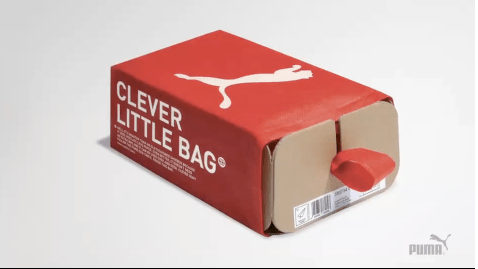
This great little video shows the length that Puma have gone to in order to completely rid themselves of the wasteful box for shipping the range of cool shoes. But having gone through a 21 month consultation process, they have radically reinvented something they are calling a bag, but still looks remarkably err, Box like.
Its saved them lots of litres of water in production, 65% in cardboard use and lots of MegaJoules in energy, but I can’t help feeling that whilst it is a big step forward, it isn’t really big enough to be that significant.
Yes, its smaller and it looks pretty good, but they have tried everything to come to the conclusion that a sort of box is still the best method by which to ship shoes.
What it is a brilliant example of however is reinforcement that good/great design and good environmental practice for any business in any sector pays for itself.
Whether they have moved away from a conventional box or not, they have saved a fortune in production costs – that you can guarantee will not be passed on in lower prices. That for me makes it, with some reservations, a good job well done by the teams involved.
Bic is one of those brands that is easy to belittle or even ignore. As they are doing most of their work in the lower end of the markets they address, it is easy to overlook them as a real brand. It’s a shame they don’t own their own domain name, but at least the existing owners do offer a link to their site.
But they are a real brand revolutionary. They have been delivering brand consistency since they formed in Clichy, France in 1945.
But I’m going to put my reputation on the line and say that I think they are a quite remarkable brand and many others could learn from them and what they do.
If I was going to summarise their brand values in a few words, I would describe them as Orange, practical, simple and functional.
None of their products seem complicated, all seem to work very well for what they are and all offer tremendous value for what they do. They haven’t been chasing upmarket like others and as such, haven’t lost their way in the process.
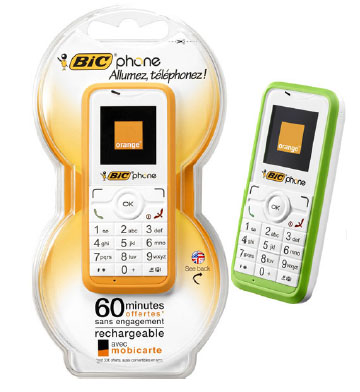
I was in Barcelona airport a few weeks ago and my eye was drawn to a Bic Phone. A bargain at 29 Euro and it came fully charged and with 12 Euro of credit on it. Even better was the fact that it was linked to the Orange Network! It looked like a good little phone and in an emergency (or an Ashley Cole) would be a good way out of trouble.
The Bic Phone – an orange disposable wonder for the philanderer or terrorist
So what else do they do?
They still have their pens, but these are increasingly nice to use and don’t seem to be as orange as they once were.
Bic Orange pens – the staple of any pencil case
They also still do a great line in lighters. Looking at their history, these were introduced in 1973 and still seem to dominate most newsagents counters. Again, lots of new colours and styles have been introduced, but they are still a sensible, functional purchase that few could regret.
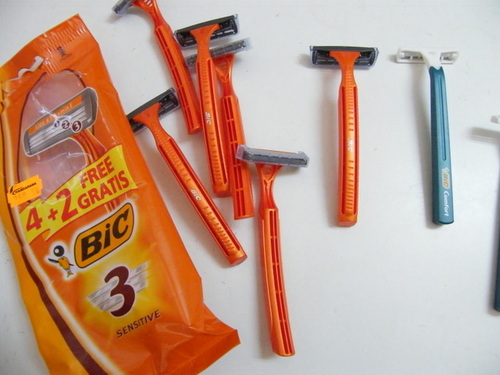
And perhaps their most famous emergency purchase was introduced in 1975 (they were pretty productive years for the Bic design team!) and is the Bic Razor. I was forced into using one the other day by having left my own in our holiday house, and it was actually okay. I was expecting to have my face lacerated like a dog had been gnawing at it, but it was a nick free shave.
Bic Razors – Orange, simple, cheap and effective
I know Bic won’t be everyone’s cup of tea as there is simply no Kudos in owning Bic, but as a brand man, I see an awful lot of bad brands out there and the Bic logo, the Bic product offering and the whole Bic brand ethos seems to have remained quite remarkably stable since they first started.
One of my team just pointed me towards this as a new TED video and I have to say I was totally enraptured with it. The opportunities for this are absolutely endless. The biggest issue we ever have with any technology is the number of wires that come with it. On our recent holiday to Andorra, half my hand luggage seemed to be full of plugs, wires and different little gadgets.
The technology itself is not that new, just this commercial interpretation of it. It was actually proposed by Nikola Tesla over 100 years ago!
This has the potential to safely end all of this hassle or wired connections and the sooner we see it commercially, the better. ANy brand that can launch the wireless charging phone has to be onto a winner. The wireless TV would be fab (I already have a few wireless radios – but they still need to be plugged in to charge them!), but trying to find wireless surround sound speakers that don’t need constant charging is something I have been looking for, for years.
These guys have done some very clever ads which I have to say are helping them build a realy powerful brand in a very crowded sector of Bottled water.
It’s well filmed and constructed and reminds me of the childhood game of mousetrap and the domino rallies we used to create (but not with Goldfish)
Have a look and see what you think.
For those of you who haven’t seen the others, here’s another brilliant one. A very brave 1:30 Ad featuring the dancing skills of Brains from Thunderbirds.
If you read the background intro to the brand which is owned by Britvic, it says this “drench® is 100% clear, crisp spring water from a spring deep within the rolling hills of Yorkshire. drench® can be found on the shelves of major supermarkets in 2L, 1.5L. 750ml and 500ml packs, providing a range of packs suitable for different occasions to ensure you remain topped up throughout the day, helping your brain and body work at its best.”
There are so many other ways that this could have been interpreted. Their decision to NOT make it all traditional and ‘Yorkshire’ does go to prove that there is still some real craft left in our industry. It doesn’t look like a cheap ad to produce, but it certainly wasn’t ludicrously expensive and yet, by playing out their own fun element of the brand they have managed to differentiate themselves from all the rather more dull and traditional adult oriented water products in the market.
It was let slip on 24th January that we would be facing a May 6th general Election and this will surely change everything, whoever gets into power.
I don’t want to be a doom and gloom merchant by any stretch of the imagination as recessions have traditionally been a superb opportunity for well managed businesses to establish a wider market share and trade through, without their weakened competitors who fall by the wayside as economic casualties.
According to Credit Action, the average owed by every UK adult is £30,226 (including mortgages), which is 133% of average earnings.
There is also the small matter of how much has been loaned on our behalf to bail out the poxy bank, which runs into the hundreds of £billions and the £200 billion that has been spent quantitative easing.
Well, from May onwards, we’re having to start paying for it through higher taxes and lower public spending, so I believe we will be facing our most austere era for many generations.
My own family had a very successful soft drinks business based in the South east that was the main supplier through the war years. When the country emerged from war in 1945 it was seen as the drab/austere choice that had almost been forced on them for the last six years and people walked away in their droves eventually leading to it’s collapse in the 60’s.
So what does all this mean for brands?
It’s entirely what you make of it!
1. It’s a chance to grab market share
By offering great value, better quality products that people care about. This is far more than just offering the cheapest price for a poor product as it is my opinion that in really tough times, people buy far fewer cheap products, they buy ones that they think will last and dispose of the discretionary purchases.
How good can you make your product for the money, not how cheap can you get away with making it?
2. It implies that online price checking will become vital
We are in the perfect economic market, where we can all check the price against anyone else out there. If the product is identical, why does it matter where you get it from – as long as you can trust them.
3. The weak will leave the market
In the design market, there are now loads of ‘design firms’ with no designers. They have a front person (suit) who then subcontracts the work to whoever is available. Yes it saves money, but it is a sure way to introduce inconsistencies and slowly undermine brand equity.
4. It is the time to reinvent constantly
Like the Lyle’s example above, I guess my Grandad stopped innovating and let his company slowly die. People became bored, because the product became boring to them. A brand has to constantly evolve and introduce new touches, tweaks and ideas or people will have excuses to flirt with their peers.
5. Don’t just cut costs, cut the right costs
In this great article from Accenture, they point out that Companies that did really well in the last recession did not just cut costs — they cut the right costs. They diverted resources to activities that actually created value.
So that’s it.
Like I wrote last year when Woolworths waddled pathetically into financial obscurity through lack of effort and like any good Cub Scout would advise.
It may be slightly more expensive, but at least I feel (vaguely) human
I booked a flight this morning to go an join my family in Spain in the Summer and as it’s just me on my own, I thought I’ll just go for the cheapest available. It’s not for long anyway. It’s only a 2.30 hr flight.
But when I went onto Skyscanner and saw the prices of both Ryanair and BMI Baby were almost identical, guess which one I booked? BMI baby was £93 and Ryanair £88.
Yes, it’s BMI Baby for me. And whilst they tried to sell me a seat selection so I could stay with my group (at £7.99 per seat and £10.99 for extra legroom seats) that I’m not in, it was a far more open experience.
I hate the Ryanair brand. It makes me feel grubby and they attempt to catch you out with every single policy they introduce from online check in to the choice of cards you choose. When I booked the flight for our ski holiday, I used Easyjet and the card payment cost me an additional £3.50. With Ryanair for the four of us that would have been £30 as I don’t have one of their prepaid chav cards to hand, which is the only way you can get out of paying a stinging credit card fee. Hmmmm.
Brands that treat their customers that badly always fail in the end. The only good thing about Ryanair is that they are keeping the others keen with their pricing.
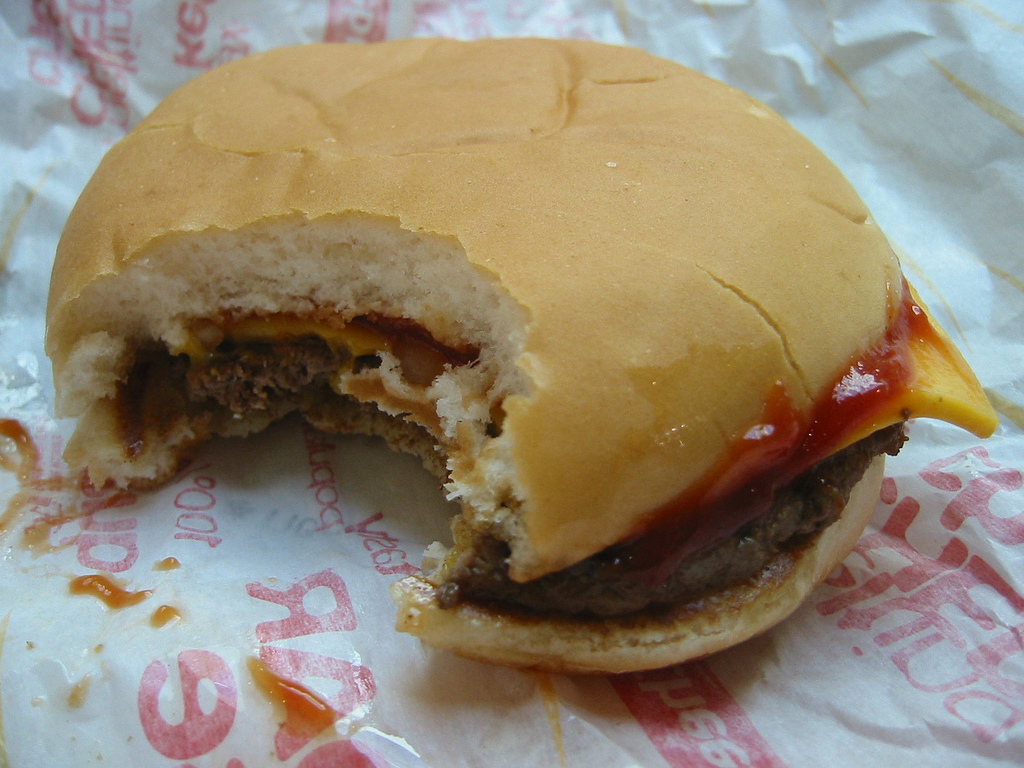
A product itself, is just one element of the overall brand experience. Like a burger in McDonalds to the Petrol in a Shell station, the product is the product is the product. It is not the brand. If it has a logo on it, it’s a logo’d product. It’s still not a brand.
McDonalds Burger – All part of the branded experience
But any product, whilst not a brand in its own right, is the start of a brand ‘promise’. If people have an expectation about a branded product being able to deliver them some ‘effect’, some feeling or some performance benefits and the product fails in that, they will start to have serious doubts about the overall efficacy of the brand itself. In effect, they will start to believe that everything else the brand owner says, must be questionable too.
There is a lesson in here for any brand owner that is well worth thinking about.
Is the quality of anything and everything you do adding to the reputation of your brand, or is it slowly undermining it for it to become average at best, or potentially collapse around your ears at worst?
In what way is it enhancing its differences?
In what way is it making itself one of one to its potential audience?
Is it honestly the best it can possibly be for the money or is it made as cheaply as you can get away with? – if it’s the latter, your brand is in trouble.
Those running brands for big plc’s may well be tempted by the short term gain and leave the longer term problems that they invariably create, to those following in their footsteps. Guinness used to say that brands were far too important to be run by mere brand managers.
For some time, there was a difference in the UK to the US with the way brands were run. In the UK, if your brand did well, you were moved on to others and left your baby behind. This hardly encouraged long term planning. In the US, the opposite applied and if your brand got bigger, so did your job. But it still remained your responsibility and you treated it with far more reverence.
In building a brand, you create layer upon layer of brand expectation and brand experience.
Using the onion analogy, a brand has many layers and a core of values. Every contact or touch point builds another layer. A good one obviously adds in a positive sense and a bad one if you’re lucky, may just peel back one layer, but still leave lots of good stuff in place.
The fear for any owner is however if your layers are thin or if there are doubts already beginning in a consumers mind, it could almost certainly undermine all the hard work you have gone into building it in the first place.
So, a product isn’t a brand, but if you get it wrong you can guarantee that consumers will make a negative connection between the two very quickly indeed.
Thanks to ‘The Food Pornographer’ for the use of her image. She’s from Perth and you can see more of her work on Flickr here and her website here.
One of the biggest changes for any organisation that is considering a new logo, is top accept that the logo doesn’t need to say what you do, and just concentrate on letting it say who you are.
Look in the yellow pages and you will see many, many ‘logos’ where there is a person with a hammer or spanner or pipe wrench next to the name of their company. These don’t say who you are, just what trade you practice. They make it impossible to extend into another area without causing confusion, but they still proliferate in ‘trade’ markets.
The really rather excellent Mr Plumber logo - A role model for any designer
By removing the ‘what you do’ element, you have to work harder to explain this, and so the second option is to introduce the strapline to attempt to explain the services offered, or the ‘what you do’.
There are hundreds of examples out there.
‘Britain’s favourite retailer’ by Tesco
This line allows them to say what they do without having to say underneath the name on the front of the shops.
It is very rare to see a logo out of context anyway. You would normally see a Tesco logo on a store, a pack a vehicle or an advertisement, so the logo is simply an identifier to say that it is ‘one of theirs’. The branding work comes in saying what can be expected by choosing a Tesco product over any other one.
A strapline is quite different to a campaign slogan such as
‘Vorsprung durch technik’ that Audi have used since the 1970’s. This was already on the wall of the factory when their German design agency MetaDesign went for a factory tour. They saw that it summed up what the business was all about and their living the brand ever since has been part of the reason for their growth to become one of the biggest car makers in Europe from their humble roots as the fabulously mad little NSU luxury car brand and their hugely innovative but incredibly unreliable RO80 Wankel engined car of the late 1960’s.
Their chosen phrase actually means ‘Advancement through Technology’ and as such, does not actually explain what the business does. The slogan therefore just adds a little more layering to the brand by way of an advertisement theme.
The big brands such as Tesco become known for ‘what they do’ because of their scale, visibility on the high streets and the (omni)presence delivered by big marketing budgets.
But when Tesco lunch into another country, they invariably work under another brand name or with a local partner. Jack Welch, in another of his Podcasts argues that it is ALWAYS more effective to buy local talent in the target market than it is to try and import it, citing their plastics businesses opening in China as a real life example.
When Tesco went to the US, they started under the brand name of Fresh & Easy, launching a much smaller format store to those they are known for in the UK and starting out from California. They therefore face the same issues as any start up. They may be better financed, but they still have to prove and refine their offer in order for them to begin to roll it out nationally. Even Tesco don’t have deep enough pockets to attempt this with a flawed or unpopular concept.
It is often argued that smaller companies can’t go down the ‘who you are’ route because they don’t have the marketing budgets of the likes of Tesco. We would argue that they could make their smaller budgets both more cost effective now and more valuable in the future, by concentrating on the ‘who you are’ now.
Focussing on a one or very few key message will always make marketing more effective and make what you do spend work in a more focussed way.
Without the ‘who you are’ you can only sell ‘what you do’. This limits the growth and expansion possibilities of your brand.
Potential customers who like what they see in the ‘who’, will go the extra mile and find out more about you, what you do and what you stand for. This creates devoted customers who both love and understand your brand.
On the day when Liam Donaldson, the Uk’s Chief Medical Officer, announced that allowing children to drink under 15 is not just a bad idea, it’s dangerous, I thought it would be a good idea to look at Kids and drinking from a brand perspective.
I only need to look at various nieces and nephew’s Facebook pages to see how many of them are drinking well under the legal age. My dad ran a brewery, so we always had lots of beer in the house but I guess our generation has just grown up with far lower price points, far stronger drinks widely available and a far more liberal attitude to drinking at home than any generation before us.
I’m not one to lecture on this as I was smoking well under age with most of my peers, but almost all of them have given that up. It does seem that smoking early is perhaps inevitable as part of the ‘trying to be a grown up’ process but at least it’s one that most grow out of. Drinking isn’t though.
From a branding perspective, getting associated as a kids drink is very bad for their long term health. It always seem to kill them in the end.
Diamond White was (I think) the first of the premium bottled ciders and after a while, gradually started moving from 275ml bottles (ie a small and controllable amount) into 500ml cans and then eventually into 2litre PET bottles. In doing so, they cheapened the brand, killed it for ever as a premium product and ensured it’s demise.
It was also announced today that White Lightning, it’s spiritual successor is being withdrawn too as the brand owners are admitting it has become a problem for them.
Andy Dawson, in his brilliant article (here) reports on the decision by Heineken’s Marketing Manager in charge of the brand Mark Gerken,
‘He admitted that white cider “is a problem drink” for the booze industry because it tends to have negative connotations with “the park bench,” adding: “We’re trying to distance ourselves from the negative images that the old traditional category had. Cider is now much more about enjoyment, refreshment, sharing and over ice.”
In other words, it used to be for tramps and now it’s just for twats’
White Lighning as shown by some of their underage core audience enjoying a quiet parkside drink
Brilliant. They are attempting to relaunch cider upmarket again, which probably means it will drift down towards being a kids drink within the next few years.
And there’s Stella, or Wife Beater to it’s friends. It used to be reassuringly expensive, now it’s worryingly cheap. Partly because they changed the recipe to allow them to hit new price points, so they could chase market share. In doing so, they took away one of the key differentiators of the brand – which was that it was far more flavoursome and better quality than other similar beers – and made it accessible to kids.
There has to be another generational change to make drinking a social occasion rather than an ‘all the time’ occasion, or there will be far more teenage alcoholics, dying kids and lots more dying beer brands.
Adults and beer brands shouldn't really try to get down there with the kids
Beer brands, like most adults, shouldn’t try to get down there with the kids, it will kill all of them in the end.





 Johnny Lyle's new brand thinking