The risks in Social Media – Direct Line style

It’s easy to be lulled into a false sense of security with social media.

We’ve lured a world famous actor to come and be our ‘face’ and recreate the look of Pulp Fiction’s Winston Wolfe.

We’ve produced a great series of TV ads with our new character ‘Mr Wolf’. They are genuinely different ads for the space in which Direct Line operate.

And then they throw it to the real wolves by using sponsored posts all over Facebook and their existing customers get hold of it.

Direct Line Harvey Keitel Mr Wolf. Social Media is more difficult to handle than you think


There are have been 224 comments in the first 14 hours and as far as I can see, every single one of them retells a story of how they have been badly treated by Direct Line or commenting on Harvey Keitel’s decision to work in the insurance market.

For me, this can be nothing but bad for the Direct Line brand. Assuming most people have 250 friends on Facebook, these negative comments have already been seen by at least 50,000 people with a negative endorsement. If you add the 223 shares, this problem could be much worse than it first looks.

Compare this to the number of views on YouTube (only 3,573 after eight days) and you can see that the negative power has been at least FIFTEEN times more effective at reaching people. It may have gone viral, but hardly the type of viral they were hoping for.

One week on and only 3,573 views for the Harvey Keitel ad on YouTube for Direct Line

Social media is both friend and foe. If you open yourself up to comments and feedback on such a public platform you need to be 100% sure you can cope with the responses. The old adage of ‘never asking a question you don’t already know the answer to’ may have been a prudent way of thinking before they ran this campaign.

I suspect a few people in the team at Saatchi (who produced the campaign) will be getting an ear bashing for their decision to try and amplify the positive effect of their advertising spend by engaging with Facebook and REAL customers.
 

The truth about Paypal – Can you really trust them?

We all love Paypal don’t we? They are friendly, quirky, simple and make all of our lives easier. The ad says so.

Or so they claim.

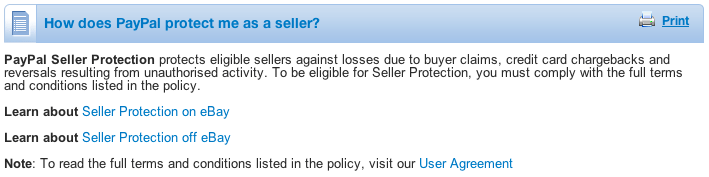
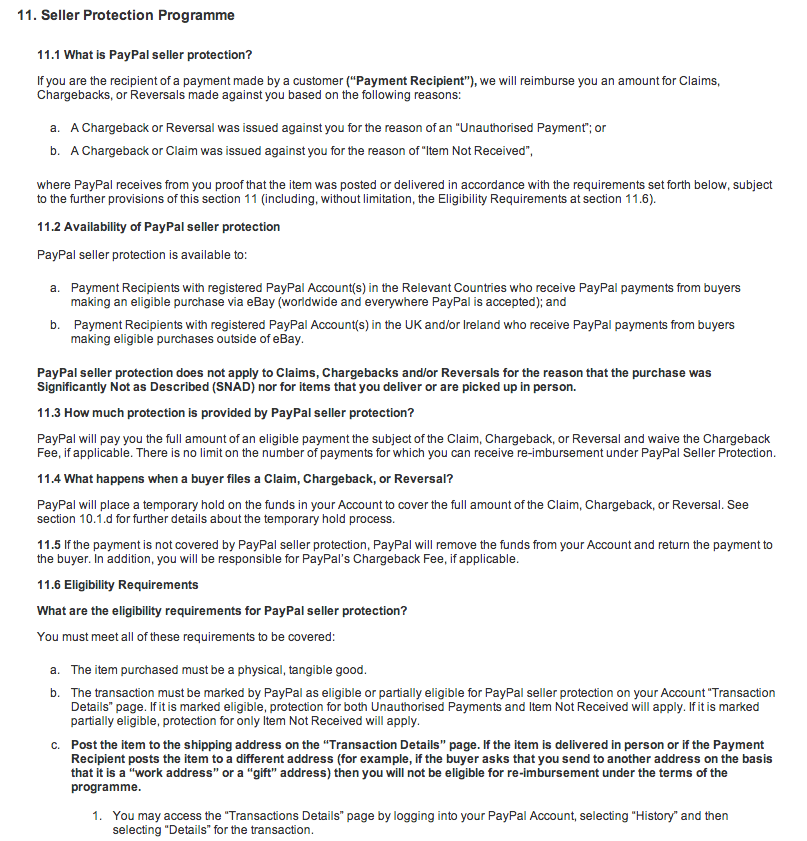
As a seller they have a brilliant seller protection programme, that protects you from chargebacks. So far so good.Paypal Seller protection Programme

But it happened to me on my data business that I recently sold. A person in the US paid £799 for a copy of my full business database, added all of the checks and balances required to pay with a credit card online. My system sent them the email with the download code and they duly downloaded it – even to the area of the city the card was registered in.

And two hours later they started a claim for a chargeback.

It’s okay i’m protected by Paypal’s first class cheeky, chirpy seller protection programme aren’t I?

But no. I’m not. Because I didn’t POST them a disk with the data on it.

So Paypal, a business that has grown entirely to serve the digital economy in which we trade, does not protect sales of items that can be paid for and transferred digitally.

It’s all clearly explained in paragraph 11.6 on page 12 of their 31 page terms and conditions that we’ve all read. Right?

Paypal Seller protection is worthless shit


How can they get away with it?

Well, apparently as the goods I sold weren’t ‘tangible’ they had no value.

Any brand that has a truth which is that far from a users reality will soon get found out. It’s an untrustworthy, rotten way to do business.

So be warned. If you are selling a service, a download a digital file or anything that won’t go in a good old fashioned letter box, then maybe Paypal isn’t for you. I’m not using them for my next business, I think i’ll give Sage Pay a try instead.


The launch of Notts TV

Notts TV Blue Duck

Today’s the day. Months of hard work, planning and prepping. Blue Ducks all over Nottingham and Nottinghamshire. Everyone clamouring to own one and be seen with the symbol of a whole new era in TV broadcasting. Millions of people reached and hours of TV produced and in the bag.

So, retune your TV’s to make sure you can see Freeview Channel Eight, sit back and enjoy the ride from 16.00 today.

It’s going to be astonishing and show what our city and the enormous bank of talent that choose to live and work here can achieve when we all work together.

This is Google, before Google was invented

I had the absolute pleasure of listening to Dame Wendy Hall on the BBC Podcast ‘A Life Scientific‘ Yesterday and she referred to a 50 minute TV programme from 1990 by Douglas Adams called Hyperland. They also played a small clip, where the ‘Software Agent’ played by Tom Baker came out with the following quote

“I’m a software agent and I only exist as what we call an application in your computer. I have the honour to provide instant access to every piece of information stored digitally, anywhere in the world. Any picture or film, any sound, any book, any statistic, any fact, any connection between anything you care to think of. You have only to tell me and it will be my humble duty to find it for you and present it to you for your interactive pleasure”

That’s Google, but before Google.

You can see it in full here 

But this just proves what a genius Adams was and that Google certainly weren’t the first to come up with the idea for what they do, they just came in and did it better than everyone else. There’s lots to learn from that.

The ‘Unconscious Uncoupling’ of Grass Roots Football

Grass roots footbal in decline in the UK

I coached kids football for five or so years with my mate who was one of the other parents. Together, we took our team to win their league at Under 12’s. It was quite a proud moment.

The reason I stopped was that in that same season I had a genuine death threat from an opposition parent (who our team had beaten) which was a little unsettling to say the least. It’s kids football, it’s not really that important is it?

But football is now in general decline at grass roots level for exactly that reason. The fun has gone and for many parents it’s a desperate chance for a ticket out of poverty. Winning is everything and if their son or daughter is the next big thing, they’re made for life. Statistically, football is the sport that it’s easiest to get rich at. Assuming the top two leagues are generally pretty wealthy, then you have around 500+ players earning mega money in the UK alone. Add in the other European Leagues and the rising Far East markets, and it’s comparatively easy. In golf or tennis, this may only be the top 50-100 in the world.

But this week, Sport England announced it has cut FA funding by £1.6m after a grassroots decline. Football is in trouble. Never before has the professional game been so completely disconnected to the grass roots game. Unless they address this, the game will just slowly wither and die. There won’t be the players coming through to feed the national teams and there may not be those growing up with football as part of their life as were were.

So, the solution?

Simple for me.

1. Make football fun again. Don’t play competitive football until they get well into their teens. Kids want to play football with their friends, they don’t care whether they win or lose, It’s the parents who do. They’ll play their competitive games in the playground anyway, without their parents screaming at them and taking the fun away.

2. Build respect into the game from the outset. The FA are now attempting to teach this to the kids, but they need to keep the parents away as normally that’s where the problems lie.

3. Keep the game sizes small so all the kids get lots of time on the ball to raise their overall skill levels. The more they play the more they will improve and in theory the more they should want to play.

4. Stop players in the professional game from swearing on the pitch and saying anything AT ALL to the referee. Look at rugby for a model here. It’s flawless and everyone calls the referee ‘Sir’ as they have ultimate power on the pitch and off it.

I don’t really care about England games anymore, I’m not even that bothered about the Premiership. I’ll always be an Oxford fan, but my love for the game and more importantly, it’s future as a national sport is in jeopardy unless they change the way the game is played at the very bottom of the footballing pyramid.

ps, Thanks to Ruby Lyle for the image of Charlie G.

The new rule of SEO

Matt Cutts - The new rules of SEO I have spent lots of time working on SEO strategies over the last few months. For years it was getting more and more complicated, but now it looks like it’s getting simpler again with the latest article by Matt Cutts of Google which puts an end to pretty much all external link building. So, how do you continue to rank your sites when Google have so much power and how do you try and force your way up the SERPS (search engine results pages)? The simple answer is that you don’t. What you have to do now is build a brilliant product or service, gather great reviews and then encourage social traffic through all of the main channels (including Google+). It’s a slow process, but the old saying ‘grow slow, grow strong’ is now 100% correct for SEO too.

Trademarking your own name

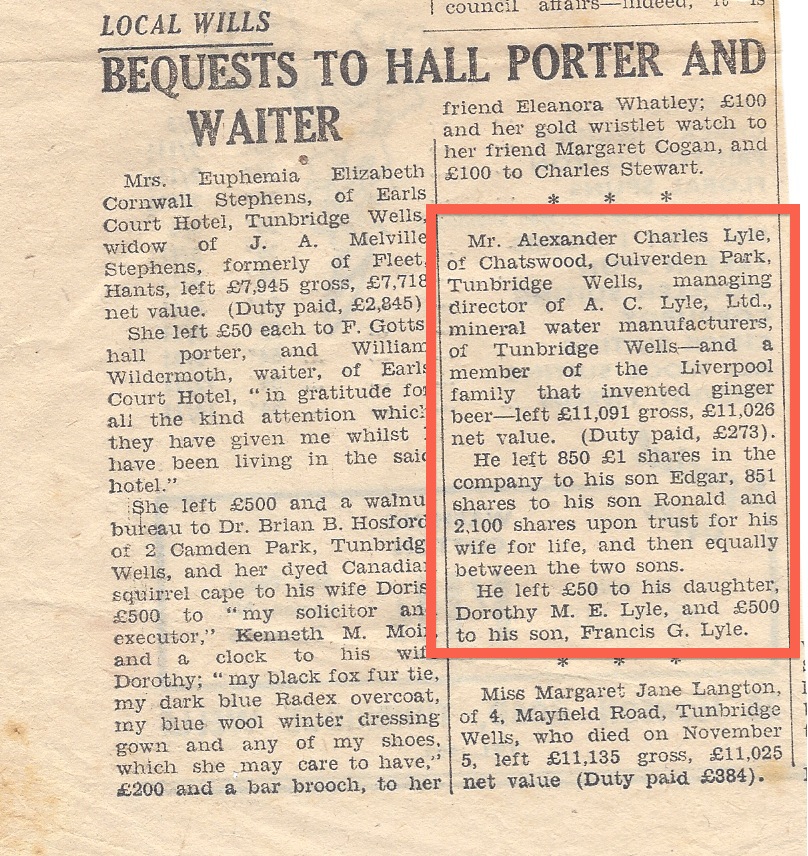
AC Lyle - The inventor of Ginger Beer
AC Lyle – The inventor of Ginger Beer

Back in 1884 my great, great, great Granny, Elizabeth Lyle  started a soft drinks firm in Tunbridge Wells, Kent. It grew and grew and survived two world wars, but sadly didn’t survive the death of my Grandfather Edgar Lyle in 1964, when the business was sold to Hooper Struve, which was in turn later bought by R Whites. His own father Alexander Lyle who died in 1953  was credited on his death with being the man who invented Ginger Beer.

I still have all the paperwork relating to this and all the others recipes that were left to me by my own Granny Jean Lyle and I promised my own father Anthony, I would bring it back to the market when I had the required experience and funds to do so. I started this process in the summer this year.

But today, this has been blocked by a rather superior trademark firm from London Venner Shipley who have contested my trademark application for the name ‘Lyles’ in the area of class 32, which loosely relates to soft drinks.

The fact that our name is a family name and the business started before their own clients’ is irrelevant. because they own a trademark and have employed expensive but illiterate lawyers (who like to use tautological expressions to sign off letters). Yes, yes, I will withdraw my application immediately, asap and promptly Messrs Venner and Shipley.

Venner Shipley

I think that’s quite sad. I also think it is truly awful that they have been allowed to send such an appallingly written letter to let me know.

For the record, the Trade Mark Office staff have been fabulous and were genuinely trying to find a way to help me get around their lawyers, but if I can’t work with my own name, what’s the point in putting my heart and soul in trying to rebuild an amazing family business and who can really afford to take these firms on?

Steve Jobs – by Walter Isaacson – One of the best books I’ve ever read

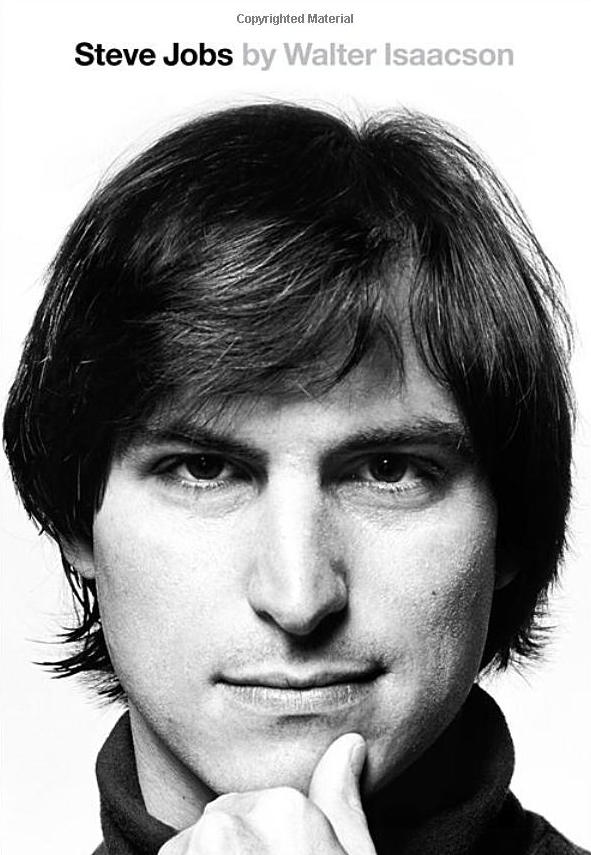
Steve Jobs by Walter Isaacson

I am a bit of an Apple fan, so when my good pal Andy Hanselman bought me this giant book as a gift, I was looking for the right time to sit down and get started on this 600 page monster. As it happened, this time didn’t seem to be materialising, so I sat down to read it anyway and I’m extremely glad I did as it is completely brilliant and inspirational, if not a little sad. You can buy it here. I recommend you do.

What it does is go through the history of the way the business developed as well as give a real warts and all account of the man himself. there’s no doubt he was a completely obsessive and extraordinarily odd man, but he was also driven by passion for detail and a search for quality like we’ve never seen before.

I advise anyone who ever asks that you have to focus on quality to build a brand, but this is what Jobs did everywhere – throughout every single aspect of the business. And, I’m convinced that this is why Apple has been so successful. That and the fact that he had an amazing design partner in Jony Ives and between them they had incredible vision too.

A few highlights for me.

1. As an understanding of why differentiation is critical – “It’s better to be a pirate than to join the navy”. Most products that come to the market do so in flocks, following a market leader. Apple deliberately and methodically went the other way.

2. On having an enemy for the whole team to focus on – “Throughout his career, Jobs liked to see himself as an enlightened rebel pitted against evil empires, a Jedi warrior of Buddhist samurai fighting the forces of darkness. IBM was the perfect foil. He cast the battle not as mere business competition but as a spiritual struggle”

3. On why the little things matter too – Jobs father had taught him that a drive for perfection meant caring about the craftsmanship, even for the parts unseen. Jobs applied that to the layout of the circuit board inside the Apple II. He rejected the initial design as the lines weren’t straight enough”. This point is again critical. Most businesses do the big things just fine. The ones that go onto become great brands care about the little things too, as this is where differentiation and ultimately, perfection lies.

Anyway, enough from me. read it. It’s an amazing and beautifully written book.