Tesco and Robin Hood – Rob from the poor to give to the rich

Tales of Tesco Hood
Tales of Tesco Hood

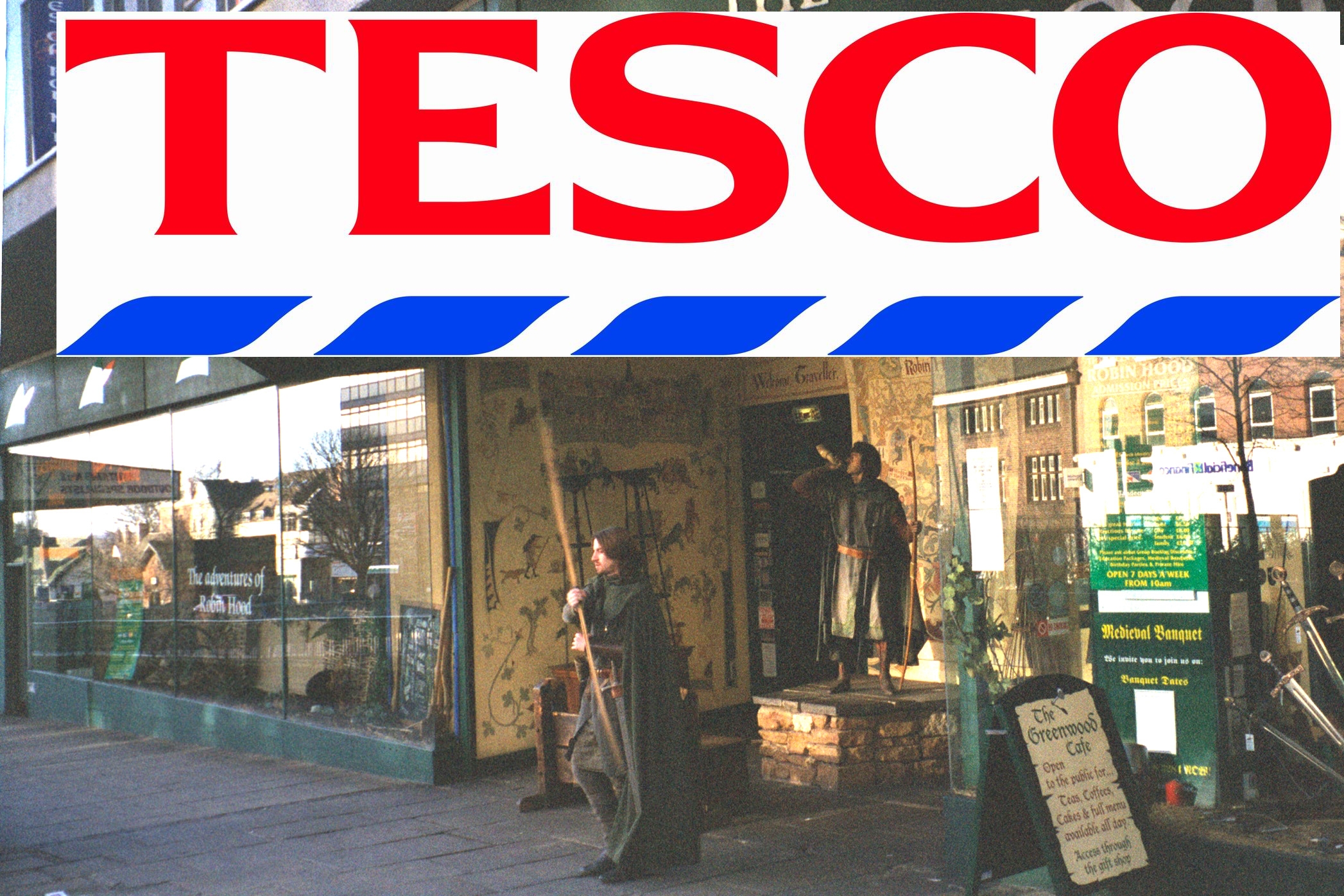
I have written before about empty shops in cities and what I believe is the solution. Flexible rents for start-ups and some understanding in the payment of business rates. The latest move reported by the BBC that Tesco were to take over the former Tales Of Robin Hood site in Nottingham, proves it’s still not being addressed in any effective way.

As one of those unfortunate enough to be on the receiving end of the presentation from the Bass Museum team who did have plans for the site, this is a real shame, but no real surprise. That proposal was so flawed as to be embarrassing.

So why would Tesco move in and not look for longer to find a decent alternative tenant?

Let’s say that the rent on the site would be £100k per annum and as we know, Tesco own the head lease. After six months empty, they will have to pay a full business rate, which adds another £41.5k to their bill. So, for them to leave it empty, costs them £141.5k per year. Therefore, as long as they lose LESS than that as a Tesco Express store, then it’s worth them opening it.

In effect they are being incentivised by the system to open up all over the place.

Surely it would be better for the long term good of the city to have some retail diversity?

Or maybe a Robin Hood attraction, or even a permanent exhibition.

Let’s set the Sheriff of Nottingham on ’em.

Thanks to the somewhat out of date Nottingham Tourist Guide for the image.

Captain Morgan Workout Video – When brands get it wrong

I’m very happy to champion a brand when they use video in a clever and funny way to enhance their brand, but this attempt by Captain Morgan to reposition as relevant today is utter tripe.

I have tried and tried to find some brand rationale as to why they would think this is a good idea. Is it appealing to a new younger more sassy audience? Err No. It’s just silly and poorly produced and so cliched, the director should hang his head in shame. As for the brand manager. Taxi……

Updated

I was very sniffy about the branding for Captain Morgan and their workout video spoof. And then I was in the pub last week and asked the bar lady to pass me the bottle over. I have to say I was pleasantly surprised by the design and the characterisation they had carried over onto the label. It’s full of charm and a lovely piece of design that is clear in what it stands for. So why is the workout video missing the point by so much?

Captain Morgan - The Original Rum

How would you like your graphic design?

How_would_you_like_your_graphic_design_venn_diagram
How would you like your graphic design - Good bad or ugly?

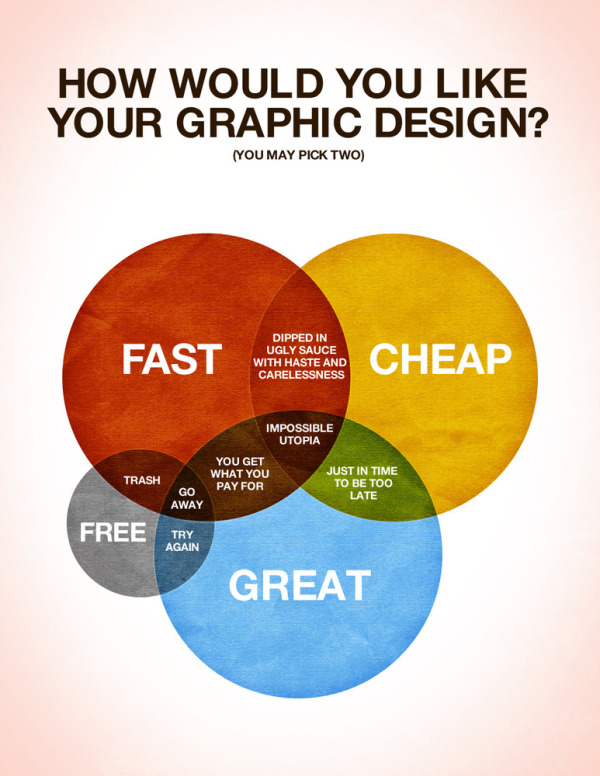
For years we have said that clients invariably get the work they deserve. The more effort they put into getting the brief right, the better the work is at the end of the process. Great design doesn’t happen by accident, it takes time, work, training, skill and experience.

It may have only taken me a few minutes to do this particular piece of work, but it took me twenty tears to learn how to do it in a few minutes.

Thanks to the team from http://ffffound.com for showing me this graphic.

How to use Twitter in ten easy lessons

Twitter_Bird_logoI’ve been asked about this a lot in the last few weeks, so thought it was worth sharing my thoughts on how to best use Twitter. Ten things you really need to know about Twitter and how to make it work for you and your brand.

1. Decide whether you are a person or a business
Twitter is used by three distinct groups: Celebrities, who like to talk about themselves and the everyday trivia of their lives; Businesses, who are talking to their customers and trying to build rapport with a younger audience and by Individuals who often use it to share gossip and news amongst their own group – like Facebook but without the pictures. An on line version of texting between each other on their mobile/cellphones.

2. Choose a good name to work with
Like creating a brand for yourself, you need to start with a good name. If you’re a business, it makes sense to choose the business name and if you’re an individual, use your own name. I simply can’t understand why someone would want to try and build another brand with a random name. It’s exactly like splitting your spend and your time across two different brands and halving its effectiveness.

3. Personalise it with an icon and all your info
When you sign up to Twitter, you have the ability to personalise your information in the Profile panel. There is lots of talk on the Twitter forums (fora?) about not following people who don’t bother with an icon for themselves as they’re probably spammers. If you’re going to do it at all, do it right and that means adding in your own URL, your own or your brand’s icon and by being as interesting and engaging as possible with your 160 character introduction.

4. Choose your tone of voice
If your brand has tone of voice guidelines, STICK TO THEM! Just because you’re speaking in a different medium, doesn’t mean you need to start being all chatty and inappropriate. If you’re an individual, decide whether you want to be friendly and engaging, cold, useful but clinically efficient or some combination. But whatever you decide, write it down as your agreed tone and stick to it in every tweet.

5. Choose your area of expertise
It’s the same for what you say as to how you say it. If your expertise is in mortgages, then why would you have any credibility talking about advertising? Decide what you are going to speak about, again, write this down and agree it with yourself or fellow contributors and then stick to it. If you are shouting about any old subject, you’ll get seen as a loudmouth rather than an expert and people will lose interest in what you’re saying all too fast.

6. Follow back
The reason I follow no celebrities at all is that none of them ever follow you back and I care very little about their trivia. Why should I care about what they’re saying if they don’t care about my thoughts? This has been escalated recently by Twitter introducing ‘lists’. Organise your favourite tweeters into lists, so you can see what they’re saying even if you’re not constantly monitoring their every tweet. This can be by subject, area of interest or even geography.

7. Tweet things that you like and that others can learn from
“Waiting for a train to Nottingham“. “On a train to Nottingham“. “Arrived in Nottingham“. And so on and on he went. The most dull set of tweets I‘ve ever seen. There were nine in total all involved this boring man’s journey to and from Nottingham. Another person, in my own industry, I used to follow said “I have to stand up from the table to let my colleague go to the toilet.” Who cares? Why should I waste my life looking at his pointless tweets? Think about what you’re saying. How will your audience learn more about you and what you do by reading what you’re writing? Would you ring someone and tell them what you’re tweeting? If so, go with it.

8. Twitter is a conversation
It’s all about dialogue, not diatribe. If you speak loudly at people, no-one benefits. Think of Twitter as a conversation and allow others to speak, retweet the things they say that you find interesting and do them the service of acknowledging when they have been kind enough to retweet your thoughts. Just because it’s online doesn’t mean you can behave impolitely. If someone serves you, you would normally say thankyou. Behave online as you or your brand would offline.

9. Build a like minded community
If you’re interested in branding and marketing, then don’t follow someone in California who is interested in real Estate or Madcap MLM schemes. When I follow someone, it’s because I think we can learn from each other. I always turn down people who are talking about things I don’t care about. It does mean I have limited myself to around 3,000 followers, but it also means that they have something to say that will be worth me hearing and that they may benefit from my own thoughts and ideas.

10. Keep listening, keep talking, keep tweeting
Stick with it. It’s a frustrating time when you’re trying to build a community. It doesn’t happen overnight unless you are a porn spammer or someone using a ‘foolproof system’ that follow millions of people and bombard them with irrelevance. But if you’re working to a plan and set aside a little time most days to work on your Twitter account, it will grow, it will be useful and it will be fun doing it.

See you in the Twittersphere.
http://twitter.com/johnlyle

Starbucks new brand

Starbucks existing logo

As a brand man through and through, I have to comment on the new branding for Starbucks.

So, i’ll nail my colours to the mast and say, that I like it. I like what they’ve done and I like their thinking, but i’ll show why and what the risks are.

1. I like it
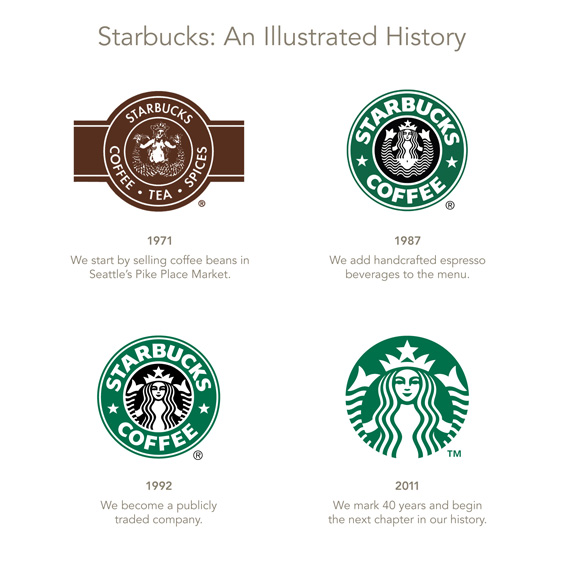
It’s an evolution. You can see from this graphic that it is the fourth major variant since they started 40 years ago, but none have thrown away the heritage, just moved them along to reflect their current needs. That’s good thinking and good branding.

Starbucks Logo - An illustrated history

They clearly cut down the number of lines they run, when they dropped spices and tea from the logo to concentrate on coffee. Well, that worked didn’t it. they are a global phenomonem that some may find addictive.

2. It allows them to go into new product areas

This is where the risk lies. Most brand owners think their brands are very stretchy and can work on anything, but very few can in reality. being known for one thing doesn’t make you cool or credible in another. Look at what happened to Porsche when they introduced the more affordable 924 (that they are apparently considering again!).

I can see them doing spices, some cooking products yes, but hardware for cooking, no. Beer, no. Wine, no. Ice cream, yes. Sweets, maybe. Beyond that, i’d be very doubtful it would have any real brand power.

I’ll watch to see what products they are trying, so if you see any before me, feel free to send them across.

Christmas shopping – Online shopping

I may not be that normal in many respects, but I do often get onto trends quite early and this year, I have shopped for Christmas differently to any other year before – and I think shopping may never be the same again.

I’ve written lots about the perfect economy, price driven shopping and how branding can help build differentiation. I’ve even written about online/offline price matching but this year it all clicked into place and a few online retailers got all my business.

Some examples.

Fifa 11. RRP £52 HMV high street price £39.99. Game High Street Price £39.99. Amazon price £24.91 delivered. Using the Red Laser App on my phone, I actually bought it on my Amazon account on my phone standing in HMV. I hope Red Laser are taking a commission.

Red-Laser-Logo

Morse the Complete Collection. RRP £199.99 (yeah right!) Morrisons £50. Amazon price £34.97 delivered. Again, bought standing in Morrisons.

And I bought from Boots, Tesco, Dixons and a few others too. All turned up in plenty of time and I saved a small fortune without having to brave the ridiculous queues at the tills in the stores. There must have been 50 people queuing in the unsurprisingly poor performing HMV. They are playing into the hands of online retailers.

Again, I don’t think i’m particularly tight, but I can see no reason at all to pay more for an identical product and the privilige of buying on the high street.

If the high street doesn’t just want to become a gigantic Amazon showroom, it needs to find a way of reflecting the price of the online retailers.

Sports Direct match online to offline, and I’ve shown before that Waterstones and HMV don’t. Which do you think is likely to still be in business by February?

How to ride a Giraffe – By John Timpson – Mini review

How to Ride a Giraffe - By John Timpson

I was given the book ‘How to ride a Giraffe – By John Timpson’ by the people from the rather excellent Real Business magazine and so thought it would be well worth a read, but I have to say that some of the first chapters really bored me – the history was fascinating but it was all a bit self congratuatory. But then it got to Chapter seven ‘Only great people need apply’.

In this chapter, rather than looking back at what a clever bloke he is, John Timpson opens up about the recruitment of Timpson’s staff. His conclusion is that if they had only tried to recruit cobblers, they would have had a choice of 30,000 people or so, but by aiming to recruit people with the right attitude, they had a far wider choice and they could easily teach them to mend shoes, given a year or so of training.

This is something that is very easy to overlook – particularly when times are tough. We are in danger of reverting to type and taking on people who are a safe pair of hands and can be dropped in to do a safe job for the business. But this can only ever put you in a holding pattern. Safe people will only ever maintain or slightly decline your business. Stars make it grow.

If you look at how US basketball teams recruit, they look for giant kids. This is their version of buying the hardware. They know that again, they can teach some (or maybe even many) of them to play basketball – ie, adding the software. You can’t teach a kid to be a giant, just as you can’t teach an experienced cobbler to be a happy person with a customer service attitude, so buy the hardware and add the software with good training and mentoring.

I’m reserving judgement as to whether the whole book is worth reading, but so far, this chapter alone makes it well worth the effort.

The Internet – creating the perfect market economy?

Nottingham's old market square
Nottingham's perfect market economy in the old days - if a seller sold bad product - everyone knew

I’ve written a few pieces recently about consumer power (and blogger power) and wonder whether we are reaching the position of a perfect market economy. That is the previously theoretical situation, where all the buyers having all the information to buy identical products.

When I studied economics at school the section I was most fascinated with was the perfect economy.

And I think that we’re almost there, because that’s the Internet now isn’t it?

All the buyers have all the information and almost all retailers are selling identical products.

And, as the theory of the perfect economy states, if all the buyers have all the information and the market is selling identical products, then people will always buy from the lowest price supplier. This has to be true, doesn’t it?

Well, no. they’ll buy from the one they trust the most, as long as the price is there or thereabouts.

My mate and business guru Andy Hanselman once said to me that ‘advertising is the price you pay for being mediocre’.

He’s right.

Products and services rise from mediocrity by being exceptional, by being differentiated and by being well branded.

So rather than the internet killing brands, it’s offering them the most incredible opportunity. A world at their feet, that’s theirs for the taking.

It’s the perfect market opportunity.

A version of this article was first published as The Perfect Economy and branding? on Technorati.

Best Buy in UK – Well no, not really

I don’t want to appear like a freaky TV pricing groupie, but I got an email this morning from Best Buy. The US phenomenon that was going to take our market by storm when they opened in Lakeside shoppping Centre.

Forgive me for being underwhelmed, but like the sad act I can be at times, I price checked them against my usual suspects Dixons and John Lewis. And guess what?

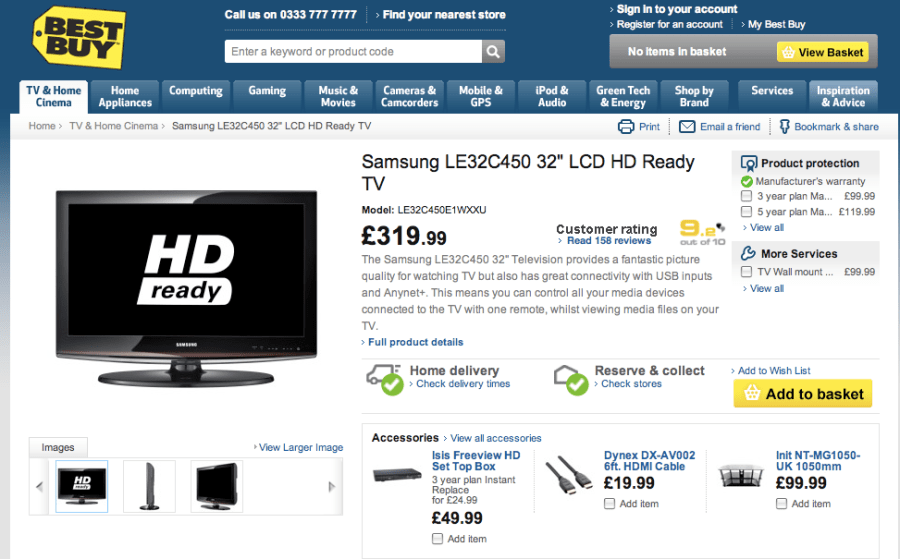
They’re really a worst buy. It’s £319.99 at ‘best Buy’ with a normal warranty.

Samsung LE32C450 32" LCD HD Ready TV from Best Buy

It’s far cheaper at Dixons at only £274.72

Samsung LE32C450 32" LCD HD Ready TV from Dixons

And an excellent value £296 with a not quite free five year guarantee at John Lewis.

Samsung LE32C450 32" LCD HD Ready TV from John Lewis

We are now working in an almost perfect market, where all the buyers have all the information and the lowest price wins all the business. For me that means you choose whether it is worth an extra £22 for a four year extended warranty (it clearly is here!) with John Lewis.

Best Buy? Brand values that deliver what they promise?

You judge for yourself.

Updated

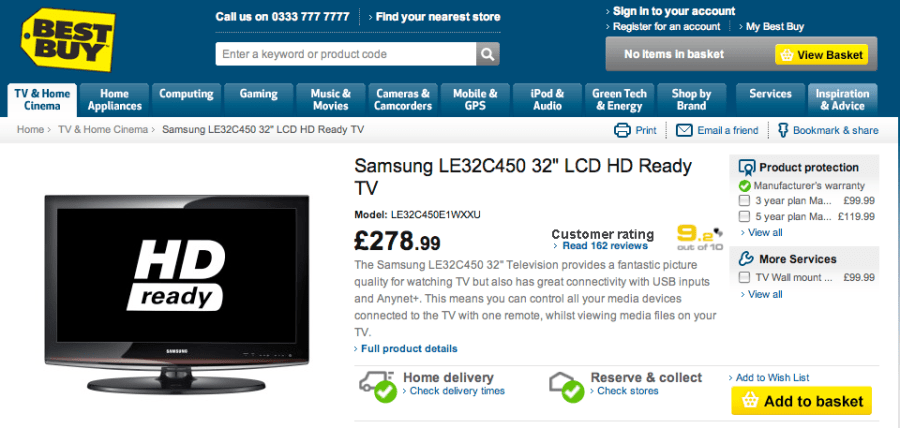
Now, i’m not going to suddenly claim to be the people’s champion, but I did notice a rather large spike in my traffic to the site yesterday and, guess what? Best Buy have reduced the price of the Samsung LE32C450 32″ LCD HD Ready TV to  a more reasonable £278.99. A reduction of £41 or in percentages, 12.8%. Is that the power of bloggers like us who Andrew Marr likes so little, or is it a pure coincidence. Again, you be the judge.

Blogger Power - the newly reduced Samsung LE32C450 32" LCD HD Ready TV