When I started out in this industry back in 1990, I used to work on projects that were broadly in the area of corporate identity. This used to be about designing a new logo and then applying it to stationery and occasionally putting the logo on a jaunty angle on the side of a van.
This has slowly morphed into the black art of branding, which seems to have its hooks into every aspect of a business and its public face.
So whilst I was writing a presentation this morning about what branding now encompasses, I was surprised to see quite how far it had come in those 19 years.
Branding is about everything, including the kitchen sink
Branding is now about every aspect of the way an organisation presents itself, both internally and externally. You first have to win your staff over, to allow them to sell the message of what you do, and how you do it, to the rest of the world.
So this is a list of what we have worked on under the guise of a branding:
Brand strategy, naming, design, management and implementation covering all physical aspects such as signage, van liveries, staff uniforms, office and retail interiors, point of sale, packaging and exhibitions.
Literature, newsletters, annual reports, white papers, direct mail.
Advertising production, photography, image management, illustration, print management, copywriting, tone of voice and language guidelines.
Website design and production, social media marketing, search engine optimisation (SEO), email marketing, DVD and training film production, TV graphics.
Online PR, marketing research and brand insight, staff engagement programmes, public speaking on Brands and social media.
Merchandise management and strategy
Have I missed anything?
The real danger here is that working in a small agency you end up being mediocre at everything and many, many practitioners do (which is why you still see lots of dreadful work out there!), but I believe you have to have the confidence to hold the brand to its absolute core values and then work with close partners to deliver the specifics in areas you have less than expert knowledge.
Our role moves more towards the brand management and less to do with the specific deliverables.
Any brand that doesn’t cover off all its public and internal facing touchpoints is leaving itself open to problems of inconsistency from the outset, so it may be a good idea to use this checklist and refer back to your brand values.
Are all of them as good as they could be, or will a little bit of new brand thinking help get your brand properly branded?
To be a brilliant brand, you have to be brilliant at everything, not great at some and barely okay at others.
Thanks to Hoppetossen for the lovely Kitchen sink image. You can see more of his good work here.
Earlier today, I was helping a friend get a blog site set up, and as I have done before with my colleagues Mich and Abi, recommended that she do it using WordPress. I was telling her about how easy and foolproof it was to use and in the very best spirit of pride coming before a fall, I fell over. Big style.
I registered her blog, in her name, on my account.
That should be simple to move, surely all you need to do is delete it and then set it up in her name from scratch?
But you can’t. You have to contact customer services and I was dreading this. They were bound to be some faceless corporate who ignored my pleas for logic and common sense, who undid all my faith in their brand.
But no, just like all of their other brand behaviours, they were incredibly simple to use.
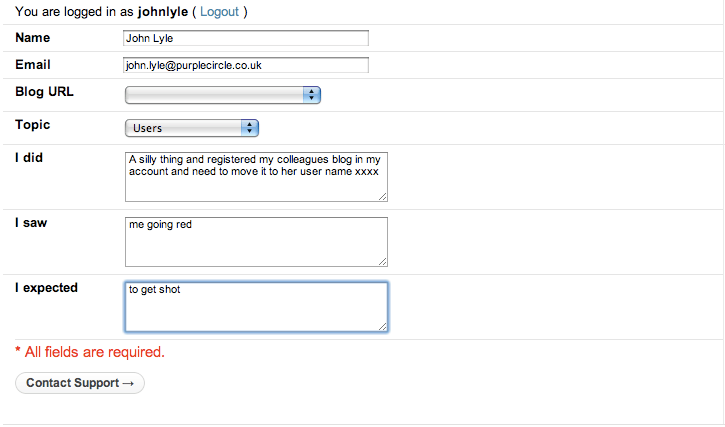
At 10.49 am I filled in the form, making it clear I was a bit embarrassed that you can see here. Even this is more nicely worded than almost any customer service contact form you have ever seen.
WordPress customer contact form – showing my grovelling plea for help
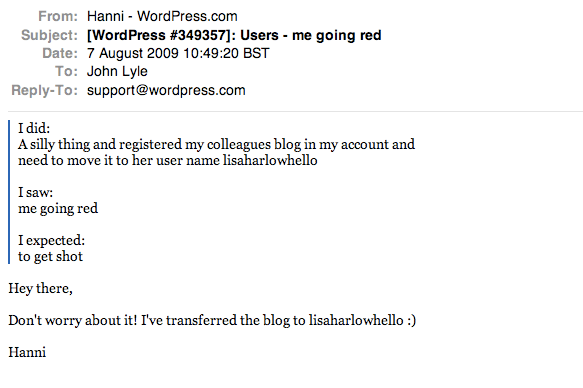
13 minutes later, the very clever Hanni, replied back, having already sorted it, using the exact language you will find almost anywhere else throughout the WordPress site.
The helpful reply from the very clever Hanni at WordPress
Any brand that can be this consistent in delivering its brand values, deserves huge success. I’m not just a fan any more, I’m a raving fan.
Thanks Hanni.
UPDATED
Many online brands are absolutely awful when it comes to working offline, but just to continue this story one stage further, WordPress have again proved they are the most human of online businesses. As is my usual trick, I let Hanni know that I had blogged about her and I even got a lovely reply. I am now a raving fan with bells and whistles on.
Twitter isn’t that new to many people, but its scarily new to others and as such, the etiquette of how to use it is only now beginning to emerge.
But to understand the etiquette, I think you first need to understand its purpose – or at least what I believe to be it purpose.
I believe Twitter is for building likeminded communities. Groups of people from around the world who share some form of common interests. Those communities can be in many or any different areas.
1. In its most high profile form, this can be for celebrity watching. The likes of Britney and Ashton Kutcher, send out inane insights into their daily lives, that few but the most committed fans could possibly care about. The fact that these two have millions of fans between them, that hang off their every tweet, shows that some people must care. I’m not one of them.
2. For campaigning it works amazingly well. Barak Obama famously built his campaign and campaign coffers on the back of his connections he built through Twitter. No election anywhere in the world will ever be the same again. The people of Iran displayed their dissatisfaction with the voting system and twitter stayed open for them to give them a voice to the outside world.
When anyone first saw Twitter, I would suspect that there were VERY few people who would have believed that it could have such a huge impact on the workings of world politics.
3. Finding and learning from likeminded peers has to me, proved the most valuable way to engage with Twitter. My work is based on the subject of branding, innovation, marketing and business psychology, so I am actively looking for people who talk about these subjects anywhere in the world on the Twitter network.
I have open searches on Tweetdeck for these words (as well as Nottingham and Margate for other reasons) and can refer to anything that is written in these areas. It beeps at me every minute and can be hugely distracting, but eqally informative.
If I see something that I think is valuable or leads me towards an article I find useful, then I will follow the person who posted it and begin to build some dialogue with them, by Retweeting their good bits and trying to read as many of their thoughts as they care to share.
But what if they don’t follow me back?
Well, for me, this is the wrong way to use the system.
It isn’t saying you want to build a community, it’s saying ‘I am very wise and you must listen to me. I don’t actually care what you have to say though, as I am far too important and time poor to waste my time with your worthless tweets’
Maybe everyone isn’t saying this, but certainly those who choose deliberately to not follow you back, are.
It’s like big business sending out emails from ‘donotreply email addresses’ They are effectively saying that they don’t care what you say, but are asking you to click through and buy from them. I covered this in more detail in the piece last week about Social media.
So, if after a week or two, people are still choosing to not follow me back, I stop following them. If they don’t care what I am saying, why should I care about what they are saying? Are they really so wise, that they have nothing to learn at all?
Not following is probably okay, or at least understandable for celebrities. I do think that it is a bit arrogant for them to only follow their fellow celebs, just to show how well connected they are, and to reinforce the fact that we are not in their ‘A’ list of friends.
So it comes back to the purpose of Twitter for the masses. Is it to build communities or relationships or just to shout about the fact you are on a train or eating your lunch?
If it is about relationships, then speaking without listening won’t keep you in a relationship for long. See how you get along for a day at work ignoring everything your colleagues say to you.
As Innocent Smoothies taught me in their book. If you’re talking you’re not listening.
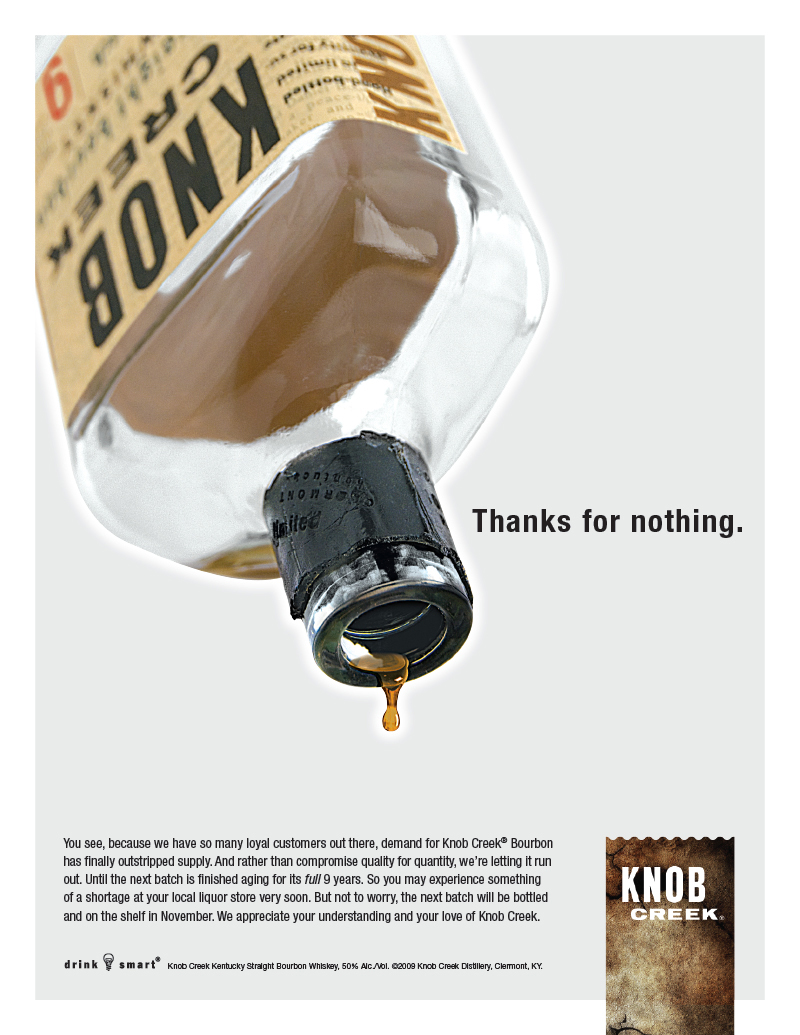
Knob Creek Whiskey, So Scarce you can't get it until November 2009
Knob Creek isn’t a brand we see too often in Britain and now I know why. You can’t get any until November 2009, as they have sold all of their production for this year.
This sounds like rather silly planning until you hear that they actually made this years batch in 2000 and then had to throw it in barrels for nine years to stop it tasting like Austrian Antifreeze.
Planning what you are going to do next year is hard enough, but to try and take a guess on what you are able to sell nine years hence must be nigh on impossible.
But the people at Knob Creek seem to have had rather a clever idea. They’ve decided to do nothing. And then tell everyone about it to prove how incredibly scarce their product is. They’ve also built folklore into the fact that they won’t compromise their quality for anyone or anything – and I have to say that this seems like a truly brilliant strategy.
Our own English hero, Sir John Harvey Jones in his Troubleshooter series, tried to get the Morgan Car Company to increase their output in order to work their way through their enormous waiting list. The family owned Morgan were one of the very few companies to ever decline his advice and have continued to go from strength to strength ever since by building on this scarcity.
Cadbury’s Crème Eggs are another great example. Between new years day and Easter, they sell approximately £45m worth of the little gooey delights and have still resisted the temptation to make them available all year round. Good for them too, a rare piece of common sense in an industry full of brand extensions we don’t need, or even much like.
In effect, what they proved was that we all want what we can’t actually have and the more we can’t have it, the more we want it.
The temptation for all three of these brands would have been to cash in and capitalise on their goodwill and brand to create cheaper, less scarce copies, but instead, they have chosen to hold their production volumes down and keep the scarcity, and as an effect of this – the demand, extremely high.
In this age of brand extensions for the sake of it, leaving your potential customers wanting a little bit more seems like a remarkably clever strategy.
Harley Davidson - A brand that really shouldn't appeal to me
Harley Davidson is one of those brands you just have to have a bit of respect for. Kevin Roberts listed it as one of his Lovemarks brands, which are those brands that are apparently loved beyond all reason.
But then I started thinking about it and looking for more background reading. This great article here in the Central Penn Business Journal gives a lot more facts, of which the most fascinating to me is that the average age of their audience has gone from 38 to 46 in the last ten years.
And that’s the whole root of the problem. The reason I have got a bit of respect for it is that I have grown up at about the same rate. Ten years ago I was 33 and now I’ve got older too. They shouldn’t be targeting me as their core, they should be aiming at people ten years younger, so I feel slightly more uncomfortable with it.
Unless a brand manages to constantly innovate and find new reasons for new people to fall in love with it, it will just get continually staler and staler until the day that it eventually dies. There will always be the die-hard fans who love it beyond all reason, but as they age and die too, they get fewer and fewer.
So Harley Davidson needs to act fast and act very boldly or it is facing disaster. It needs to make itself cool for a younger audience again.
One way they could do this is by embracing social media, so I thought I would have a look at what was available on YouTube. The first video that Google threw up is here.
Great idea Harley Davidson, but when you get comments like this, you know your problems are more deep rooted.
‘WTF is this? A video showing ASIANS riding a HARLEY!? LOL! WTF! Well, this is a commercial video. BUT REALITY is: ASIANS don’t care about harley davidson motorcycles! ASIANS ride scooters and JAPANESE sportbikes! I am ASIAN, i personally ride sportbikes and dislikes american made harleys! Only old and fat ass americans ride those ugly cruisers! LOL!’
Backing Buell as their ‘new cool’ brand won’t be the answer either. For me, all this will do is split their marketing budget across two brands. Ultimately, this just makes your marketing more expensive. Buell isn’t a minor sub-brand, it’s a whole new name with a different set of differentiators and a different target audience.
So how should they do it?
For me, there are three simple ways, all of which use some form of social media channelling.
1. Get cool people riding them
Whilst not my cup of tea, getting a youth hero like Zac Efron, Ashton Kutcher or even Britney to get photographed riding one. Zac Effron is a bit of a nipple, in my opinion, but if you can buy ‘High School musical’ spectacles now, there has to be some huge youth power in their branding.
2. Get cool people Twittering and blogging about Harley
Ashton Kutcher is the most followed person on twitter, Britney is third, when they tweet, 5.65 million people listen. A little bit of their coolness would have to rub off.
A blogger outreach programme to find the most influential people in the blogosphere would pay massive dividends too and create a huge stir amongst the new younger target audience.
3. Stop fat old Americans riding them
Any of the previous role models need to be ditched. There must be a slash and burn policy for fat old and unhip people to get off their bikes. Start rumours they are too powerful for old people and make them feel like they are dad dancing with the wrong brand.
And then they have to get people like they have already, away from managing their brand. They have to get a young team to advise them on how to take it forward – even if it makes them feel very uncomfortable. There are certain things that 40+ year old men shouldn’t do. Try and be overtly cool is one of them. Harley Davidson is well into its 105th year and needs to start acting like an excited teenager again.
Good luck.
UPDATED
It would appear that Harley Davidson are indeed trying to capture a younger market by allowing their brand to be used in some fake ads in the youth Series True Blood. As has been reported by Rippin Kitten here. The great thing for me is that I was told about this article by Tony Long at Cultural Exception via Twitter. You can see his work here. This is what i love about Twitter. We can all learn from each other.
Not knowing the series, its hard to comment too specifically, but the look and feel is very Twilight and I know how much my 13 year old daughter loves this! Good work Harley, all you need to do now is get the fat blokes off your bikes.
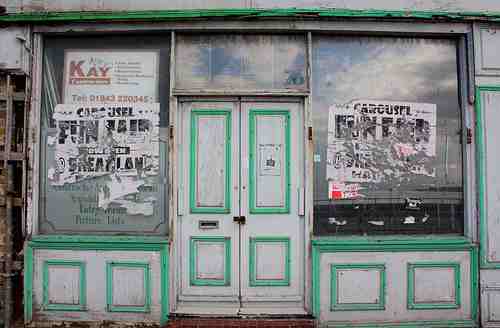
Empty shop in Margate – A chance for the independents
There was lots in the news on the BBC on Friday about the seaside town of Margate having the worst percentage of empty shops for any town in the UK with a 25% rate. This was closely followed by Derby, which for a major urban conurbation has an astonishing rate of 22%.
Now I know both of these places very well having grown up in Margate and have written about it both here and here, and I live within a few miles of Derby.
So I thought I was in a good place to comment on both places from a branding perspective and from a common sense perspective. The two are often quite separate and for me, this seems to have been the case in both of these examples.
So firstly Derby. It’s a compact city that has built it name on the back of engineering with Rolls Royce, and latterly Toyota and Bombardier. It used to have a lovely friendly small city vibe to it but was always slightly ‘chippy’ about its relationship with Nottingham, just a few miles along the A52. It seemed to spend more time looking at what Nottingham was doing and trying to compare itself favourably to it, rather than looking at organising its own offer. It has been branded as the city of the future, Derby yes and I don’t know how many other silly place branding attempts. All have failed to capture what is great about the city, which, for an outsider looking in, is that it is easy to get around, friendly, very good looking in places and quite nice to live or even shop in.
So when they announced the huge new Westfield development, it was almost like they had got off with the best looking girl at the school disco. Nottingham and Leicester looked on jealously as to what massive wealth this new shopping mecca would bring them. But unlike with the retailer, Wilko’s you can’t always polish a turd.
I’m not saying Derby is a turd per se, but I am saying that what they did was built a huge great homogenous monstrosity in the heart of a lovely city that had no connection with the city itself. They built an out of town soulless shopping experience in the heart of a city that was full of soul. It had no connections to the outside world. They drew their best retailers from the streets into the centre and in doing so, pulled out its heart. They forgot what made Derby both different and great and with 22% of their shops empty, are now reaping the rewards of their greed, stupidity and short sightedness.
The story with Margate is remarkably similar. A lovely little east Kent seaside town that had lost its sparkle, become the home to bail hostels and low end living and with its obvious lack of investment over the previous few years saw huge ££££ signs ringing in front of its eyes when they allowed Land Securities to build the monstrous Westwood Cross between its main towns of Margate, Ramsgate and Broadstairs.
Again, they dragged the heart out of the towns, Margate suffered most as it was already in decline anyway, but all saw their multiple retailers leaving in droves to create even more homogenised and soulless developments for us to travel to and endure.
But in recessionary times, we all seem to work out that you can only own so much stuff and then it has to stop. Well, we stopped.
I am convinced that brands have to fight back by being different, not by being homogenised. I don’t want to look like the next person in the street, I want to look like me.
The future of branding is unbranded.
So the towns and cities need to fight back. Not through another pointless rebrand that will just get the local people and the local papers baying for blood, but by deciding what they stand for and then offering real incentives to drive the right people to deliver that into place.
If you want independent retailers, then the councils have to be flexible. Why not offer them rent free periods or even licenses rather than onerous long leases that scare the start ups away. If you are thinking about starting a small business, would you feel comfortable about immediately signing a lease that commits you to five years of rent payments whether it works out or not? No me neither.
Business rates could help too. At present, any business pays 48.5p for every £1.00 of assumed rental value in its business rates. So if it’s arbitrarily decided that your space should be rented at £10,000 per year, you would have to pay £4850 in business rates over and above any rental or lease payments. But again, in recessionary times, this space is worth nowhere near what it has been in the past, so there needs to be a huge degree of flexibility exercised here. If landlords are having to take almost zero rent to get retailers back into spaces, surely the rates should be calculated on what they actually pay, rather than what they should be paying in some imaginary, ideal world economy?
Margate and Derby have a glut of retail space, so they need to make it incredibly attractive to independents to come along and give it a go, without the huge downside risk they would normally face, so that independently minded people will come back and begin to shop there. In my mind, only something as radical as this will get the spaces trading again. No amount of art in the windows will do this, but all credit to Margate for starting to make empty shops at least look more attractive.
Margate shop window art – an imaginative use of empty retail spaces
Empty spaces are self perpetuating. Fewer people will take the risks of setting up and as such, fewer people come to their to shop in the first place.
As with any recession, this is a chance for Derby and Margate to define their character. They have already sold their souls and found that it isn’t as great or profitable an experience as they once hoped. Lets hope they take this chance now to recover their fighting and independent spirit and maybe even save their souls.
Thanks to Melita Dennett for the Margate empty shop shot. More great work from her here. And to Maggie 224 for the Margate art shop – More of her work here
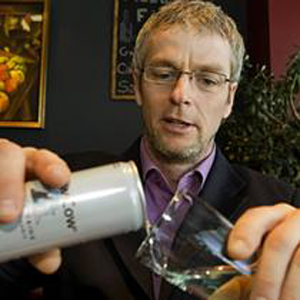
Lino Fleury Troublemaker in chief at Slow Cow - The anti energy drink
There’s a battle going on about the branding of livestock based named drinks and its all been started by a Canadian man called Lino Fleury – a name for someone whose going to be different if ever there was one.
It’s all to do with who owns what ‘properties’ or ‘brand values’ in an energy drink.
On the one hand Lino’s new baby ‘Slow Cow’ is an anti energy drink. A concoction he has created that according to his story contains L-Theanine, an amino acid found in tea plants that’s meant to help you achieve a relaxed, focused state of mind. He’s even got some friendly doctor to say it is probably natures best kept secret. But I don’t actually believe that and I’m pretty sure he doesn’t either – surely nature’s best kept secret wouldn’t have been found yet?
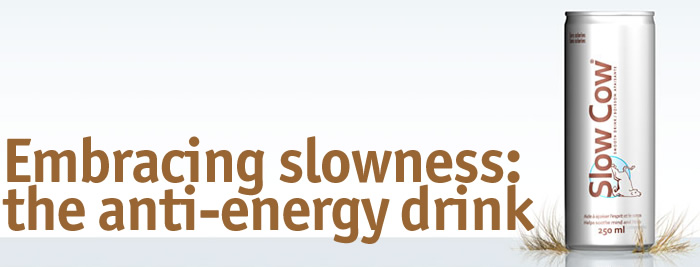
Slow Cow Ad - Everything that Red Bull isn't
For some reason, the people at Red Bull are none too impressed and have sent our hero Lino a notice to cease and desist. Even though for me, the brand values are at the opposite end of the spectrum.
But I absolutely believe they haven’t got a leg to stand on as the entire basis of the branding is completely different. They haven’t got a wing or a prayer of succeeding in front of any competent judge.
The brand basis of red Bull is to help you achieve more, to push yourself beyond normal limits. Their sponsorship of the Air Race series, F1 cars and any seemingly mad adventurous activity has to confirm this. For me, its entire reason for being is to convey energetic enthusiasm.
Red Bull Air Race - Its energy all the way
Their active ingredient of Taurine is widely copied in every generic ‘energy’ drink in any supermarket. Tesco settled out of court with Red Bull in 2007 for an undisclosed sum for apparently being too close in design with their Tesco Kick energy drink – but that’s more likely to be because they sell red Bull and didn’t want to lose the contract.
Aldi sell a six pack of Red Thunder (for £1.49!) which comes in identical sized and coloured cans to those of Red Bull, but as they don’t sell the branded product, they are unlikely to decease or delist!
Slow Cow, at the total opposite end of the scale, is all about taking time out, about slowing down and maybe even taking yourself a little less seriously. It’s about marking a time to begin relaxing rather than to begin being a bit excitable. Who would try and look ‘cooler’ by drinking a drink called, Fat Sloth, Ugly Dog, or spunky Monkey – let alone Slow Cow?
I would also counter the argument even more strongly that the packs look similar. They don’t. One is cream and the other is red, blue and silver. If you confused the two of them side by side, you would be stupid or lying under oath. The only similarity I can see is that they sit on the same beverage shelf and they are in the same sized can.
Beans come in the same sized can as peaches and are also sold in supermarkets, but you would hopefully think it was yourself at fault if you accidentally had them on toast, not the people who put them in the can in the first place.
This is bad PR by Red Bull and very clever PR by Lino Fleury. The two products are literally chalk and cheese and any talk about them being in the same trading space is utter, utter nonsense.
This is one of the most exciting and informative presentations about Social media I have ever seen. There are so many lessons to come from it that it seems obvious to pick to what I think are the main few for us to learn from in case you don’t have time to go through it yourself.
1. If your product is crap, no amount of social media will make it less crap.
2. Listening is the most important thing you can do. Social media is about building dialogue and not diatribe. As innocent said here, when you are talking, you are not learning. Most research departments do not send out the emails, it’s the sales departments and they rarely ever speak.
3. Sending emails from ‘do not reply’ addresses is just plain rude and bad for business. What you are saying is that ‘We are speaking and not interested in what you are saying, so shut up’ – unless you want to place an order – in which case ring this 0800 number or click through to our friendly smiling website.
4. 85% of social media users have said that they expect companies to have a social media presence and then use it to actually interact.
5. Having a strategy to engage is the way forward. Look at all the social media options, decide what is right for you and then dive in.
6. Stop thinking social media campaigns and start thinking social media conversations.
7. And the three final rules in summary.
Listen
Engage
Measure
If you don’t measure its effect, how do you know if its working?
And thanks to Andy Hanselman for showing me this presentation via Twitter.
Wilkos has for years been the dowdy daughter of the British high street, toiling away as a cheap hardware store with no particular positioning and not enough real reasons to visit them regularly. Not quite posh enough to be John Lewis and a (big) step above the Poundland and super low price retailers.
The lovely Old Wilkos storefront
But, when Woolworths died, Wilkos made their move.
And they have proved that you can occasionally polish a turd. The new branding created by Jupiter has given them a much more youthful new look that will have a positive effect in many ways. It feels more like an Aldi than an Argos and will hopefully deliver them the growth they deserve.
Wilkos store front - like Woolies with evolution
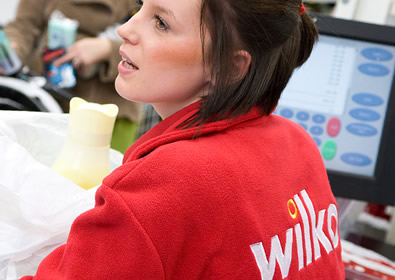
The staff must surely feel far more motivated in their new colours than the previous red/yellow cheapo combo.
The new Wilkos staff uniform
The customers will fee less embarrassed about being seen with a WIlkos bag and with good PR could even help themselves position their purchase as ‘discerning or savvy chic’ rather than the ‘best kept secret’ on the low rent end of the high street.
They seem to have so many things right that it’s like seeing what Woolworths should have become had they evolved rather than allow themselves to curl up and wait to die. Wilkos have Pick and Mix, but it takes up a small proportion of the store and not the huge area Woolies devoted to it before their demise. Yes, it’s high margin selling sweets, but you can only shift so much of them!
And, like any really good retailer they have concentrated on value rather than price. Goods of an appropriate quality and at a sensible price.
The only downside for me is the rather horrid queuing system you have to endure in order to pay. It all looks a bit like a bad bank. Maybe they’ll do like Natwest and take the clocks out so no-one can see how long they are queuing for? or in a more positive light, perhaps the softer, more airy approach of TK Maxx or even Primark would be a better solution?
Anyway, good work Jupiter and good luck Wilkos. It takes a brave (and extremely sensible) client to implement such a radical change.
Thanks for the old Wilkos image to the lovely people of Zyra
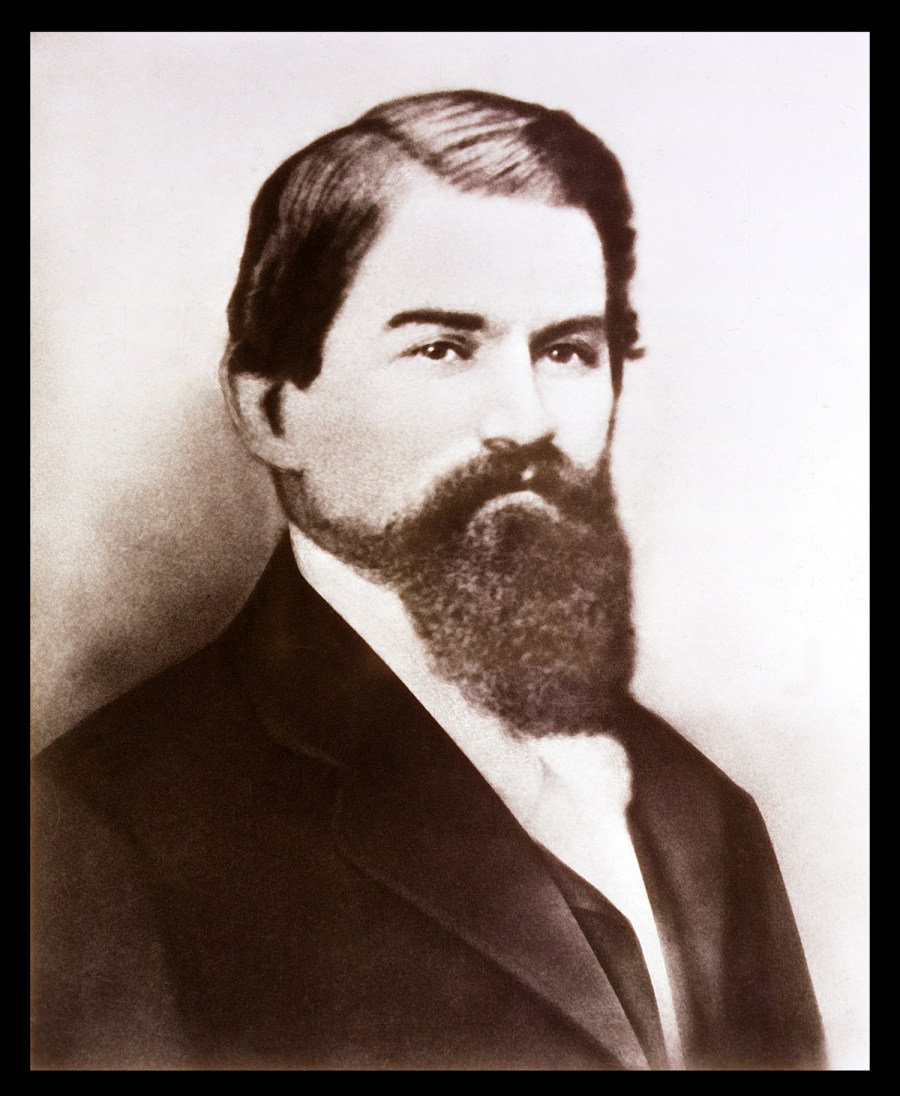
Dr John Stith Pemberton – Gave birth to Coca Cola and started the Cola Wars
On May 8th 1886, a Dr John Stith Pemberton, a pharmacist, gave birth to the Cola Wars when he made a new syrup for the original Coca Cola and sold it down the road at Jacobs pharmacy. It was many years before it became the enormously powerful brand it is today.
What is one of the most interesting points for me however is that the logo element was actually produced by his bookkeeper who thought he could see something in the proximity of the two C’s and with his own scripted handwriting, created the logo for use in the Atlanta Journal to invite the citizens to try their new refreshing beverage. As you can see, this ‘logo’ is almost the same as the one we see today.
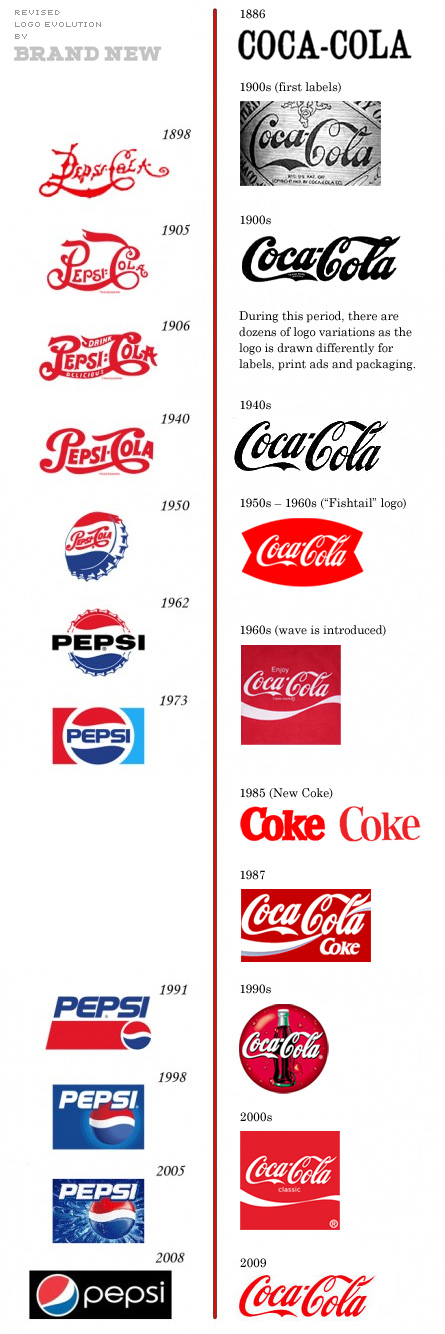
Meanwhile in 1898, over in New Bern, North Carolina, Pepsi was invented by another pharmacist Caleb Bradham. It was originally launched as Brad’s drink, but later became Pepsi Cola, named after the two main ingredients of Pepsin, the digestive enzyme and Kola nuts. Again it was aimed at a market looking for a refreshing drink that had some beneficial effects. The logos at this point are strikingly similar, to the point of Pepsi’s looking remarkably like a copy of Coke’s.
But around about here, their stories seem to split. Coca Cola stuck to their mission and continued to modernise to reflect the needs and desires of the era by changing the context of their traditional logo. Pepsi on the other hand, tried to modernise by constantly changing the logo and the context.
Pepsi and Coke logos throughout their history
In the 1980’s, during the time of Roger Enrico’s stewardship, Pepsi became convinced that their difference was their taste, spending the next ten years promoting just this one point and may even have been the reason that Coke, changed their recipe to one of their few historical mistakes that is ‘New Coke’. You can read a bit more about this here.
But by constantly trying to change everything about their product to appeal to become the choice of the (next) new generation, Pepsi effectively created a continual churn of their existing customers. The Pepsi logo that seems most relevant to me is the one from 1973 and the one for my kids will probably become the one from 2005.
The lesson here is simple. Coca Cola are the market leader and have been throughout their history. They have done this by continuing to build on their original values. The logo has evolved, but never changed so radically that it will lose its connection with the previous generation. Because of this brand continuity, Coca Cola will always mean something similar to each of us.
If you blind taste test Cola from Aldi at £0.25 per bottle and compare it to Coke at £1.09 per bottle, they are not that different, so like I said with the branding of cigarettes, it has to be to do with the brand that is the difference, or we would always buy the cheaper alternative. We don’t though, because the branded values dribble down on us and give us a bit of their magic.
Branding is not about logos, it’s about the consistent delivery of values to allow you to gain a feeling or emotion from it. The logo is only the symbol to show you have arrived at that branded experience.
The logo is therefore not the most important element of any brand, it’s the continual reinforcement of those values.
Pepsi’s mistake has been that by constantly changing the logo, they have changed the symbol of arrival.
As such, every time they change it, they create a level of uncertainty in a potential customer, rather like going into a pub or office you don’t know, that it may not be to your taste. You will naturally ask yourself ‘Will it be the Pepsi I know? Or have they changed it to make it more relevant to a new more exciting and younger audience? Will I look silly if I drink it? My very own equivalent of dad dancing in the wrong room.
Changing logos is a mistake, that Pepsi have practiced for year after year after year. For me, this is why they will always be trying to follow Coca Cola’s lead.
UPDATED
It would appear from new information that my previous chart showing the branding of Pepsi v. Coke through the ages was wrong. Shock Horror, they have actually changed the logo over the years. Not much, but still amazingly consistent considering the length of time.
It’s been announced that Coca Cola are undergoing a radical new look and feel again. What is really interesting to me in this is that their idea of a radical rethink is to move some of the colouring around on their trademark bottles and cans. They are still leaving the logo element of the brand almost completely untouched as they have done throughout their entire history.
Coke updated bottles April 2106Coke updated cans April 2016










 Johnny Lyle's new brand thinking