It’s not research it’s brand insight

I’ve spent all morning today with the extraordinarily clever Barrie and Vicky from Park Lane Research who have been teaching us all about Brand Insight.

In the old days, this may have come under the misnomer of market research, but it’s been rebranded and seems to work a bit better now.

As we start to work on bigger and bigger projects as a design and branding business, we are increasingly asked to justify our ‘gut feel’ and experience school of advice with some real figures and some data that is valid (rather than assumed).

The real difference between brand insight and research is twofold for me.

1. There’s no fence to sit on, no focus group to hide behind and no weasel to worm you out of a difficult question. You simply speak to your customers or perhaps those who aren’t your customers – and then find out what they think. You listen and then act. Not use them as a crutch because you’ve already acted and need a friend on your side.

2. The second and most exciting one for me is that brand insight looks to the future. Every example I’ve seen of market research seems to be retrospective. It’s taking an historical perspective on what has happened. Brand insight is far more about making a more informed decision about what is likely to happen in the future.

I am an avid fan of Twitter and believe that I learn something new almost every day, but yesterday was a bit of an epiphany day for me with one of the most remarkable comments I have ever read – that will genuinely change the way I look at branding going forward.

It came from someone I had never met before whose name is Joelle Nebbe-Mornod and can be found on Twitter under the name of ‘iphigenie’ and who is blogging here.

What she said was …

‘The perverse effect of branding is that it creates a need for control – control every bit of message, because a brand is so fragile’

I talk a lot about message management, and edged towards control, but had never considered a brand to be fragile, even though I have written about brands for years. This statement has made me think that if we are to protect any brand, any product and any organisation in what is becoming the economists perfect market economy – where all the punters have all the information they need to make the perfect buying decision, we have to be pretty clear on our facts.

Hopefully, with our new brand insight partners, we’ll move beyond simple control, we’ll move to freedom. We simply want to produce better products that we are happy to put our name, brand or mark to. The better we make the products, the stronger we make the brand. If it is cool, you love it, it makes you feel good and it is better at what it does than anything else on the market, surely everyone wins?

Except the cheapskate competition.

We can only hope. Thanks for the following picture from Patrick Looney.

We can only Hope
We can only Hope

Margate fights back – Rebrand or no rebrand

Margate, fresh from its appalling rebranding attempts on The Apprentice is most definitely fighting back.

I wrote this article last week and found myself defending the place quite vigorously.

By way of follow up, I have just spoken to a very helpful ‘spokesperson’ at the Tourist information centre and they report that the town was absolutely packed this weekend with thousands of families looking for the type of break that Kate’s team were promoting.

I think there are a few things to learn from this. The first is that the opposite of love isn’t hate. It’s apathy and maybe many of us had got a little apathetic about Margate and British resorts in general. Maybe this programme forced many to look again at their own prejudices and get down there and judge for themselves?

The second and perhaps most important point is that in our own experience of place branding, you need a catastrophic event to start the fight back. There were so many people being negative about the place generally that those of us who have lived there and loved it, stand up and shout back at those who put it down – particularly those who have never even been there.

This has happened in Liverpool, where there is huge civic pride from almost all who have lived there. We saw the same happen in Nottingham when we went through the rebranding process there and maybe the same is starting to happen in Margate.

Margate Old Town is beautiful, the Turner Centre should be spectacular and bring in a whole new audience to visit the shops, cafes and bars of a regenerated town without all the homogenised high street stores we see in every other town and city the world over. If Margate dares to be different, it has a chance to succeed. If it bottles it and homogenises it deserves to fail.

Rebranding any place in isolation will achieve absolutely nothing. Using it as an excuse to show people you have changed and will behave differently going forward has the potential to really work. This applies to ANY brand, be it place, product or service.

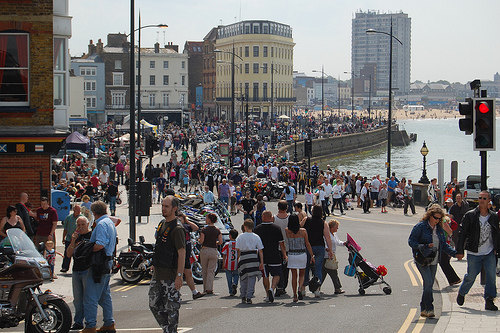
A busy Bank Holiday in Margate

Thanks for the shot which is from Blood Oaf on Flickr. See his excellent work here.

What are the eleven rules and three checkpoints for brilliant branding?

This is my checklist for starting to look at any branding project, in order to capture where the business and the brand already is.

As I’ve said in my work for Purple Circle Branding and on many occasions, branding is not about logos, it’s about a whole raft of ideas that come together to create an overall branded experience. Think of the logo as the marker to know you have arrived at the correct place and you’ll see its context. For me, the brand experience covers every aspect of an interaction or even a potential interaction – so therefore manage it.

In some particular order with the most important first.

1. What are its values and are they published for all to see. More importantly, is there evidence of them actually being lived throughout the organisation?

2. Is the merchandise/product/service supporting the brand experience and actually making it more positive or undermining it by not being as brilliant as it should be?

3. How does the brand speak and look visually? Is it on brand and consistent in every application that’s out there?

4. Has it defined its customers. Can you see from what you are looking at who it is they are expecting to engage with/sell to – and is it who they are actually targeting?

5. How does the website work. Does it look the part, publish the values and really live them?

6. Are the logos being used of a consistent feel. Not necessarily all in the same place and at the same size (as this is just consistent logo usage) but creating the same sort of effect wherever they appear?

7. Are they practicing CRM or MCR (maximising Customer relationships) by engaging with customers in every positive way possible?

8. Is there evidence of customer feedback. Do they use a product such as Feefo to ensure they are constantly engaging with their end users. In effect, are they engaging in dialogue or just giving them diatribe?

9.  Are employees engaged and leading at every level. Are they ‘chattering’ externally in a positive way using social media platforms? When you meet or speak to them are they brand advocates, or sales prevention officers?

10. Does the marketing collateral also talk the talk or does it drift towards the desperate in its sales message or continue to reinforce the brand, create the tribe and sell the dream.

11. Is the SEO on track too? A brilliant brand understands writing for SEO and is employing the best techniques throughout the experience.

This is all well and good. There are now only 11 things you need to manage to make a great brand but from this, you need to define three more final things.

1. What are the problems caused by low scores in any of these areas?

2. What does success in any of these areas look like?

3. Conversely, what does failure in any aspect look like?

These are obviously only rough guidelines and there ill need to be a variation for any specific sector but as a brand owner if you manage all of these well, you won’t be far off a great brand.

Here are a few examples of ones I’ve worked on over the years.

A stunning article on new brand thinking

This is a stunning article from FusionBrand in Malaysia, commenting on the poor year had by Ogilvy and Mather in China and the reaction of their chairman TB Song.

Read it here

What it says to me is that the future for branding and advertising agencies is a very uncertain one unless they begin to offer measurable ROI on what they do for their clients. This means measurability everywhere.

Rewarding advertising agencies by how much space they buy for you is a dead model. Rewarding them by how much sales revenue they generate will help sharpen their ideas in a massive way, but only if they are allowed to control more of the experience than just the televisual element.

As a design and brand agency it was traditional that we could change logos and create wonderful new design literature, websites, direct mail and all sorts of marketing ‘collateral’ that would win over clients the world over.

But those days are gone. We have to change the core of the businesses now, in order to change the brand.

Brands are born in the customer experience and not in the logo you choose to hang above it. The logo can only ever be a symbol that the customer has arrived in the right place to enjoy their branded experience. Change the logo in isolation and you change nothing. Change the customer experience and mark it with a new logo and you could indeed change the world for that customer.

Unless we have enlightened brand owners who allow designers to enjoy and subsequently manage the ongoing brand experience, one of us will disappear. The old adage ‘if two people in a business always agree, then one of them is unnecessary’ rings truer now than ever before.

Branding as topic that has been fiercely debated and that everyone has an opinion on (right or wrong). Done well, it changes the basis of a business forever. Done badly, it’s a poor old waste of money that brings the industry into disrepute and has been practiced by many since Introducing Monday and Consignia started the trend downwards with the most pointless and superficial logo changes masquerading as rebrands.

So, to all enlightened clients feel free to get in contact and I’ll show you the difference between a new logo, a pointless change and a really brilliant piece of branding that will directly benefit your business and its customers in the long term.

One bad brand experience will taint your brand forever

We’ve been having problems with T-Mobile and their Blackberry services for months. Every time it sent and email to one of our handsets, it bounced back to tell the sender it hadn’t arrived.

Helpful stuff – particularly as it did arrive and we had people ringing and complaining and all sorts.

We rang T-Mobile on loads of occasions and no-one seemed to want to own the problem and get it sorted.

Finally, I rang to give them one last chance or we were going to shift contractors and then we spoke to Jean.

She took control, involved her techy helper Jason in the problem and was simply brilliant. She promised to call me back five minutes later and then did. She said she thought she had an idea what was causing the issue and would be back to me shortly. Sure enough, she rang back to confirm that it was now mended. It turned out to be something very simple at their end, but no-one else had looked in the right place.

She even said she would call back the next day to ensure the problem had been resolved. Guess what, she did at exactly the time she agreed.

So I thought I would write to their press office telling them they had a star in their team and they should praise her and shout about her from the rooftops.

They sent me back an email almost immediately letting me now they were dealing with it and would be back in touch within 12 hours.
And guess what?

They haven’t been. And its now 42 hours later.

Poor old Jean. She is trying to turn around an underperforming brand single handedly and no-one else seems to be backing her up.

Remember, just ONE bad brand experience will taint your customers view of you – potentially forever.